
Louis Brea, Predella of the Altarpiece of Saint Margaret of Antioch
On display
Louis Brea stands among the most talented artists of Liguria at the turn of the 15th and 16th centuries. He created this predella for the altarpiece of the Saint Margaret church in Lucéram, depicting the major episodes of the life of Saint Margaret of Antioch, a martyr of the 3rd century.
Having rejected the advances of the Roman General Olibrius by confessing her Christianity, she was condemned to torture, which she survived through the power of prayer and the cross, until her fatal beheading. She triumphed over the dragon, embodying the Devil, and the forces of Evil by piercing it with her small gold cross. The animal, deprived of its usual deadly flames, roared in pain.
It is worth noting that Saint Margaret, the patron saint of Lucéram, was venerated in the Middle Ages for the assistance she was believed to provide to women during childbirth, a feared stage often fatal for both the child and the mother. The altarpiece, considered as an active and effective object, was thus intended to renew the miracle of deliverance in everyday life.
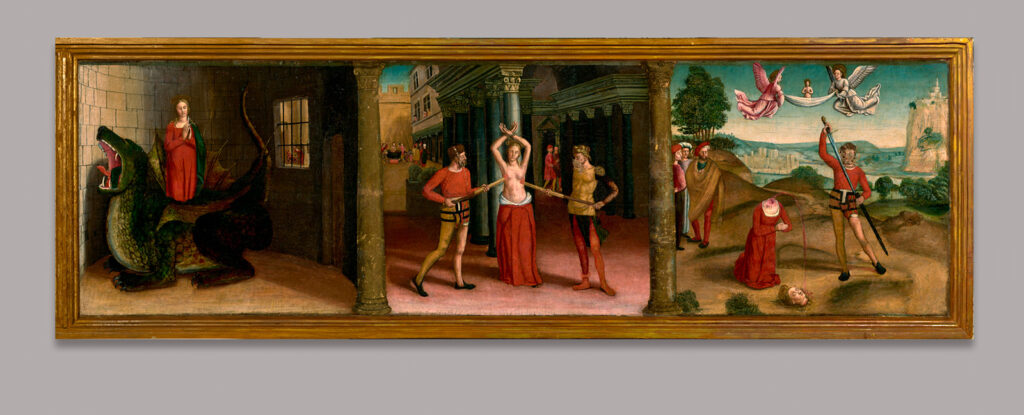
1498-1500, oil and tempera on panel, 46.5 x 160.5 cm
Nice, Jules Chéret Fine Arts Museum, N.Mba 255
Purchased by the City of Nice in 1882
© François Fernandez
Agnolo di Cosimo, known as Il Bronzino, The Crucifixion Around 1540
On display
This masterpiece was identified in 2005 as a work by Bronzino, created for the private chapel of Bartolomeo and Lucrezia Panciatichi’s palace in Florence. It had already been praised by Vasari in his Lives, a publication considered foundational in art history.
Executed by one of the foremost representatives of Florentine Mannerism, this work is atypical compared to his other paintings and those of his contemporaries. It is notably distinguished by its extraordinary sobriety: the absence of movement and vivid colors, characteristic of Mannerist art. This choice is thought to reflect a specific request from the patron, hypothesized to be associated with adherence to Protestant Reform and its new liturgy.
Nevertheless, the work is connected to Florentine artistic history: the architectural framework, as well as the prominence of mathematical perspective, evoke that of Masaccio’s Trinity (1425-1428, Santa Maria Novella church, Florence); the technical prowess, creating the illusion of life in the crucified Christ, fits into the paragone, the debate between painters and sculptors seeking to determine who could best represent the reality of the world in their medium.
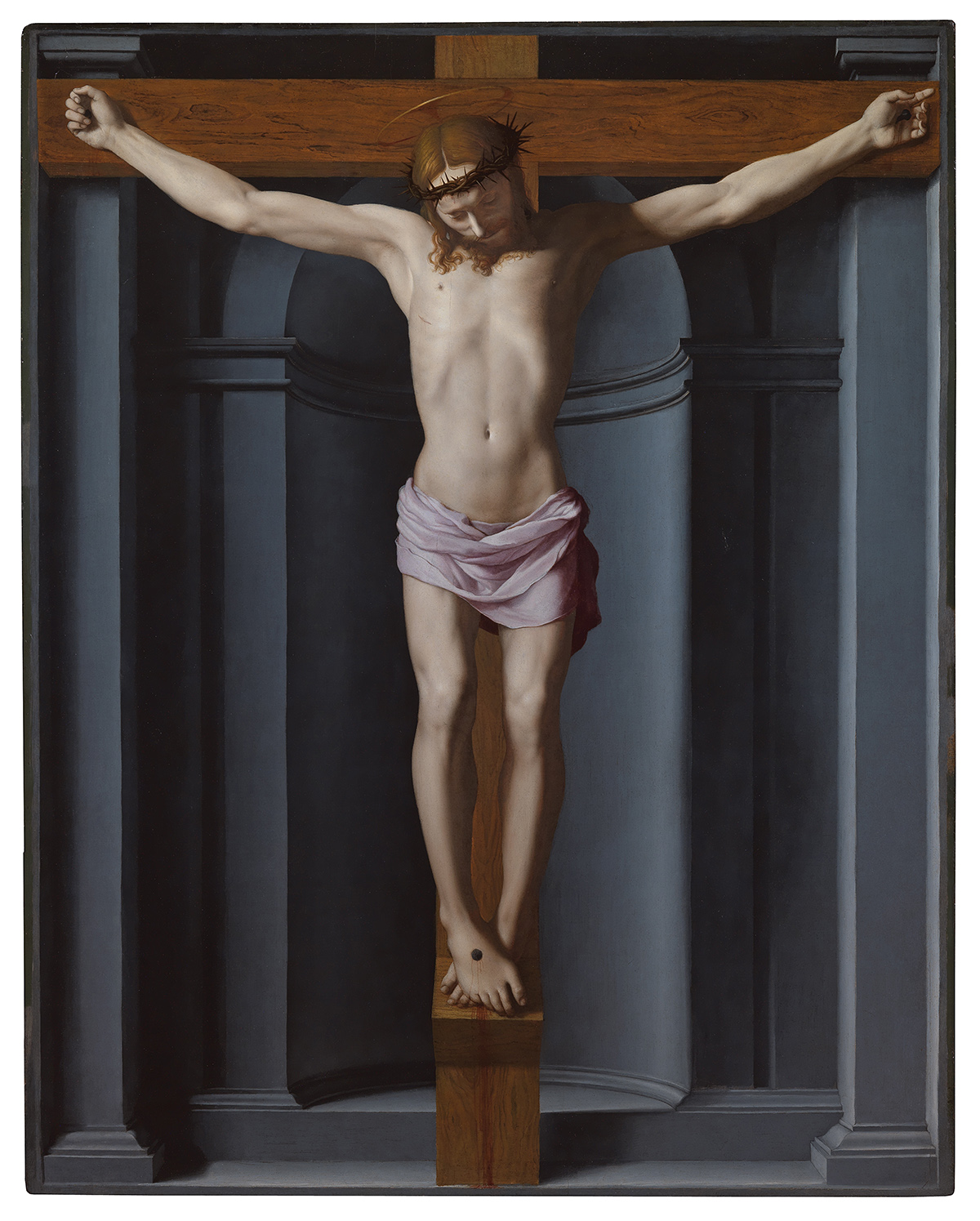
circa 1540, oil on poplar wood, 145 x 115 cm
Nice, Jules Chéret Fine Arts Museum, N.Mba 196
Donated by Mr. Hippolyte Defly in 1879
© City of Nice
Anonymous, Naples or Germany (?), Cabinet, Antiope and Andromeda
Not on display
This type of cabinet was intended to store small collectible items. The materials used, ebony as well as ivory, enhanced the preciousness of the ensemble due to their rarity. Here, the ivory has been engraved, and ink has been applied into the grooves to bring out the design.
The two female figures depicted on the central panel are heroines of Greek myths. On the left, Antiope is about to be seduced by Zeus, who has taken the form of a satyr; the sons born from this union will be the founders of Thebes. Andromeda, on the right, is less fortunate: to appease the anger of Poseidon, she is condemned to be devoured by sea monsters, chained naked to a rock. She will eventually be saved by the hero Perseus, who immediately falls in love with her.
The motifs displayed on these ivory plaques were mostly inspired by engravings on paper that circulated throughout Europe.
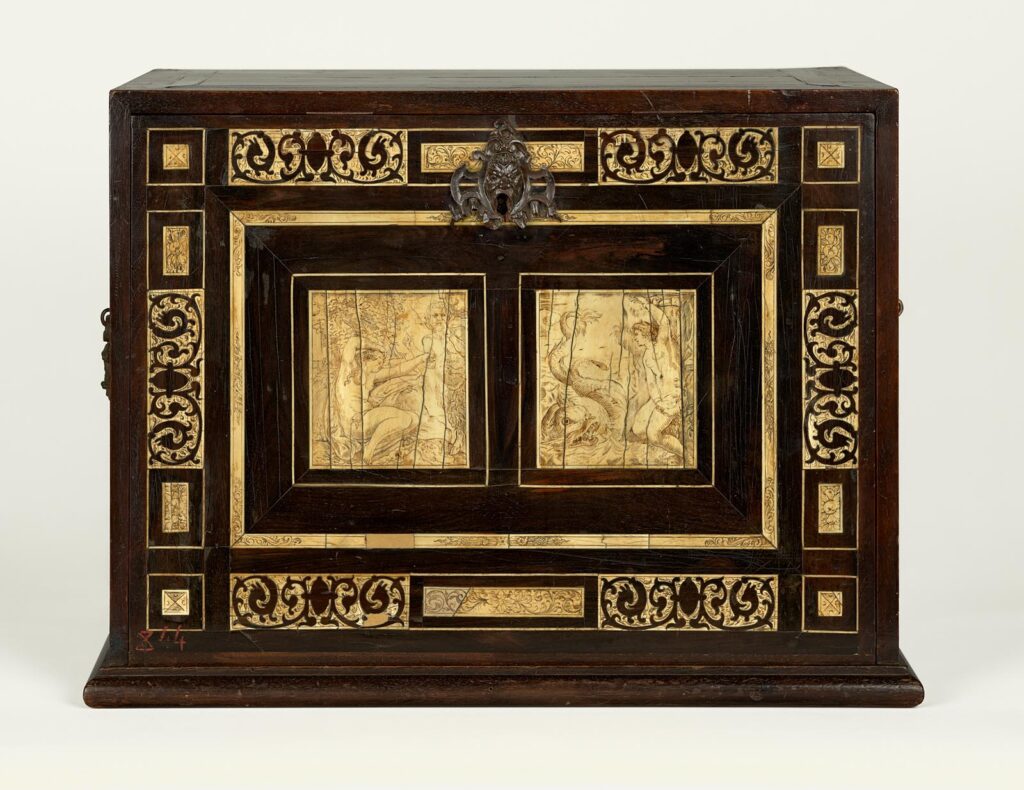
16th century, wood, ebony, ivory, bronze, white metal
Nice, Jules Chéret Fine Arts Museum, N.Mba 844
Bequest of Miss Fanny Trachel in 1903
© François Fernandez