
Genesis of the Museum
The creation of an art museum in Nice was later than in other regions of France, which can be explained by the specific political history of the area. Before 1814, while Nice was part of France, the city was not populous enough to benefit from the revolutionary distributions that formed the first Fine Arts museums in the region. After 1814, when Nice returned to the Kingdom of Sardinia, it did not receive the same attention as, for example, Chambéry, which, despite being less developed, was generously endowed by Victor Emmanuel II.
However, after the annexation to France in 1860, several factors combined to make this institutional project possible. The demand from winter visitors, toward whom the local economy turned in the 19th century, grew increasingly strong. These visitors also attracted many artists looking for quality models and exhibition spaces. The taste of Napoleon III and Eugénie for the arts and the desire to develop the new territory of the Empire, including culturally, led to the sending of important works, which required an appropriate venue. Locally, a French administration aware of the evolution of museums in the rest of the country, along with the influence of local intellectuals and collectors, ultimately brought the project to fruition.
Foundation and subsequent moves
An apartment on Rue Saint-François-de-Paule
The will of Augustin Carlone in 1868, bequeathing his fortune and art collection to the city on the condition of creating a museum, marked the institution’s beginning. The museum took shape in 1875 in an apartment on Rue Saint-François-de-Paule, adjacent to the municipal library, where several works had already been displayed since 1872. The location was chosen for its proximity to the library, which managed this first museum, and its presence in the neighborhood of key social hubs for art and literature enthusiasts.
At the museum’s opening, the collection comprised paintings, statues, antiquities, and historical memorabilia from various restricted-access establishments, as well as those accumulated in the municipal library. In 1876, Lacoste described it as a “rudimentary gallery” and suggested it be named “Carlone Museum.” Before the museum’s establishment, other works were scattered across places like the municipal theater, the city hall council room, and the prefecture, including paintings from French and Italian schools deposited by Napoleon III’s administration since 1861.
Critics soon emerged, lamenting the new museum’s lack of space and light. It also couldn’t host the Salon of the Nice Fine Arts Society (SBAN), created in 1877. This society aimed to “support the protection of old art works and historical monuments in the department” and “strive by all means to construct a Fine Arts Palace for its exhibitions and, more generally, all art events the Society decides to promote or favor.”
Initially, Abbé Justin Montolivo likely oversaw the collections. In 1885, the works were under the supervision of Antoine Bottero, the municipal archivist, who also managed the library. Alexis Mossa later became the first dedicated curator. After several years in Paris, Mossa established himself in Nice, earning a solid reputation as an artist and actively engaging in the SBAN. He also entered politics, becoming a councilor to Mayor François Alziary de Malausséna.
After two SBAN Salons held in the former Portallier gallery, which had since become the Fama property, Mossa convinced the mayor to install the municipal Fine Arts museum there, transferring four hundred works.
A small temple on boulevard Dubouchage
In 1889, the museum moved to the Portallier gallery, a neoclassical building designed to better meet the institution’s needs. This period saw a significant increase in donations and acquisitions, greatly enriching the museum’s collections.
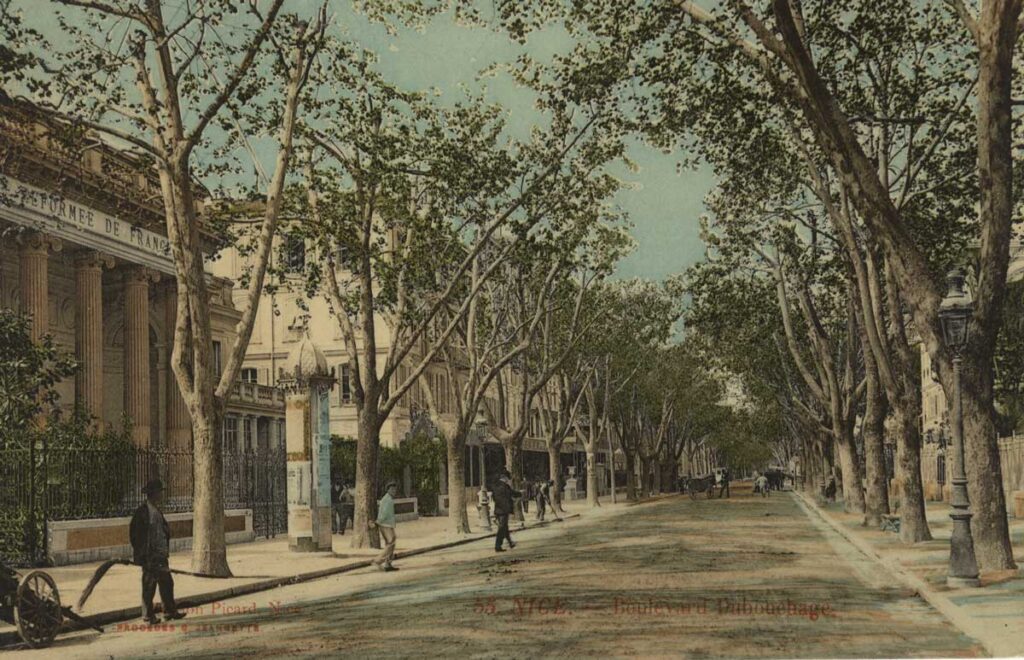
Under Alexis Mossa’s leadership, the museum grew significantly. Mossa, a recognized artist deeply involved in Nice’s cultural life, organized temporary exhibitions and enriched the permanent collections through strategic donations and purchases.
An apartment building on avenue Notre-Dame
In 1901, the museum relocated again, this time to a specially adapted building on Avenue Notre-Dame, where it continued to develop and gain notoriety.
The building offered an ideal layout for displaying works, with two main ground-floor rooms for engravings and sculptures and several exhibition rooms upstairs, accessible via a staircase adorned with artworks. The spacious, bright first-floor rooms allowed for chronological and thematic displays, facilitating an immersive experience in various artistic schools and periods. Rooms were named after donors, evolving with new donations or the spirit of recent hangings, featuring names like Rothschild, Carlone, Fabre, Gambart, Defly, Van Loo, Trachel, Brouillet, Ziem, Chabal-Dussurgey, Felon (replaced by Bashkirtseff in 1917), Bréa, Biscarra, Deloye, and Etex.
The museum on Avenue Notre-Dame quickly became a leading cultural venue in Nice, contributing to the city’s artistic growth. It served as a showcase for local and international artists and a center for education and preservation of Nice’s artistic heritage. Innovative management and varied programming allowed the museum to meet the expectations of an increasingly diverse and broad audience.
The esteemed institution that the people of Nice had long desired finally took shape in 1925 in the form of a sumptuous Belle Époque mansion on the hill of Baumettes.
A palace on the hill of Baumettes
In 1925, the Kotschoubey-Thomson villa was transformed into a palace of arts following its acquisition by the city. Renovation work, led by architect Nicolas Anselmi, adapted the space for exhibitions and artwork conservation.
The “Palace of Arts, Jules Chéret Museum” was inaugurated on January 7, 1928.
These historical elements are excerpts from the text “Le musée hypothétique, pérégrinations d’une institution niçoise” by Johanne Lindskog, published in “La bataille des Beaux-Arts. Art et politique à Nice au XIXe siècle,” edited by Snoeck.