
Xu Yang, Inspection Tour of Emperor Qianlong in Southern China. Crossing the Yellow River (Huanghe)
Not on display
In a scroll over 16 meters long, Xu Yang immortalizes Emperor Qianlong’s journey through the Chinese provinces and the Yellow River (Huanghe), the fourth emperor of the Qing Dynasty.
From right to left, the meticulous depiction captures the emperor’s journey until his arrival on the other side of the river. The delicacy of the lines, the finesse, and precision of the details attest to the high degree of technical skill of the artist.
Of the twelve scrolls painted on silk using a very ancient technique, only four are known to exist today: one at the British Museum, one at the Guimet Museum, one in a private collection, and the last one at the Jules Chéret Museum of Fine Arts, a jewel in its vast collection of Asian art.
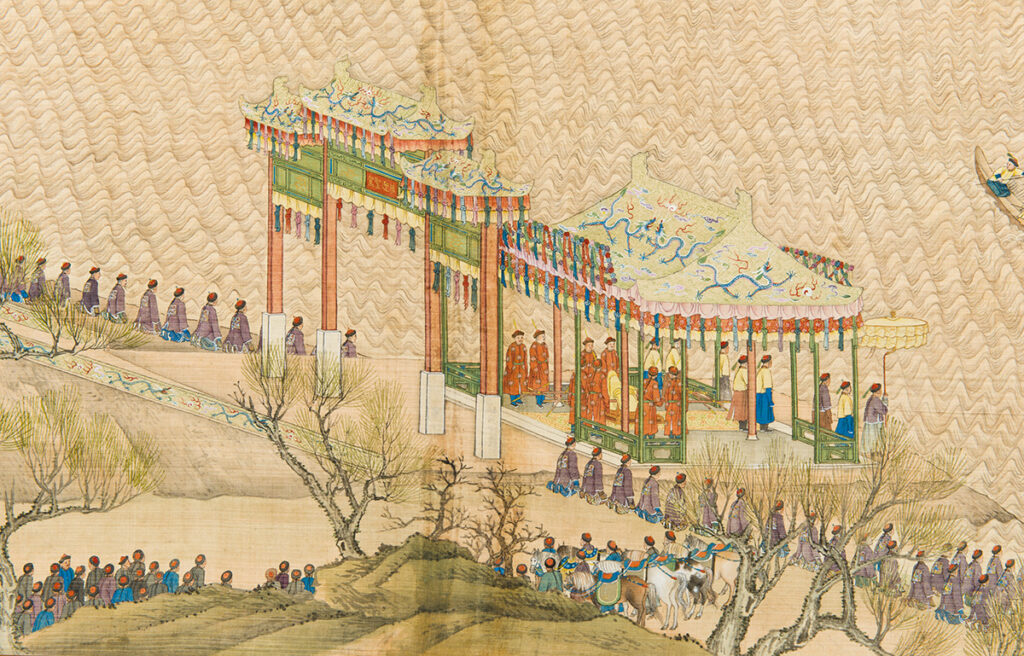
Around 1765, ink and color painting on silk mounted on paper, 0.70 x 27.03 m
Nice, Jules Chéret Museum of Fine Arts, N.Mba 2498
Donated by Baron Joseph Vitta in 1935
© Laurent Thareau
Jean-Honoré Fragonard, Portrait of an Elderly Man
Not on display
Master of 18th-century French painting, Fragonard usually excels in airy and colorful gallant scenes. Here, there is no extravagance or lightness. An elderly man is depicted in a very realistic manner: the thick clothing in a range of browns and dark reds, the face marked by age, radiant in the light and enveloped by the curls of his golden beard and those of his light white hair. The man is peaceful and focused, his hand brought to his chest. His determined gaze gives the portrait all its depth and liveliness.
Its magnificent carved frame, donated by Baroness Vitta in 1948, emphasizes by contrast the sober background of the figure and reinforces the majesty of this portrait.
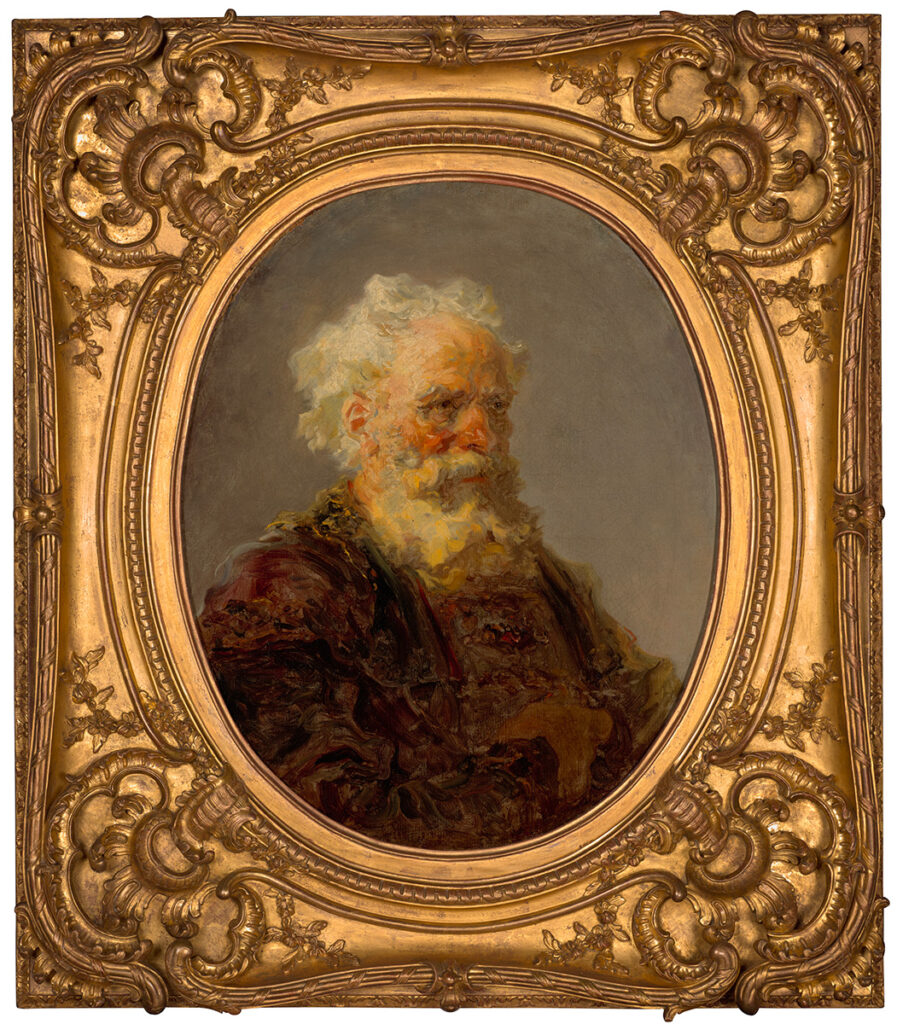
circa 1765, oil on canvas, 60 x 50 cm
Nice, Jules Chéret Fine Arts Museum, RF 1945-27
On loan from the Louvre Museum in 1946
© François Fernandez
Charles-Amédée Van Loo, The favourite sultana with her wives served by eunuchs
On display
In the gardens of a palace, seated on a pile of cushions, a ‘sultana’ is preparing to share a cup of coffee with her attendants. The many servants are carrying the serving utensils; one kneels on the right and brings a coffee pot, cups and saucers on a tray; the black servant on the right of the Sultana is about to pour the contents of the pot into her cup. The Sultana is smoking the chibouque, of which there are other examples in the background, along with a brazier. This imaginary composition takes us on a voyage of exoticism and fantasy to an Orient that was still unknown but deeply attractive to the social elite of the 18th century.
It is in keeping with the fashion for ‘Turqueries’, which is reflected in a number of motifs, from carpets to fabrics, from the chibouque to the furniture supporting it, and even the presence of a black maid and coffee. From the 17th century onwards, and especially in the following century, coffee, along with chocolate and tea, became increasingly popular as exotic drinks.
This composition by Charles Amédée Van Loo (1719-1795) was commissioned in 1772 as part of a series of five cartoons entitled Le Costume turc (Turkish Costume), to be woven at the Manufacture des Gobelins. As the title suggests, the series was intended to evoke the ‘Customs and Fashions of the Levant’.
Article by Viviane Mesqui, Museum Curator, Sèvres – Musée national de Céramique. Text taken from the exhibition catalogue ‘À Table! Le repas, tout un art’ exhibition catalogue.
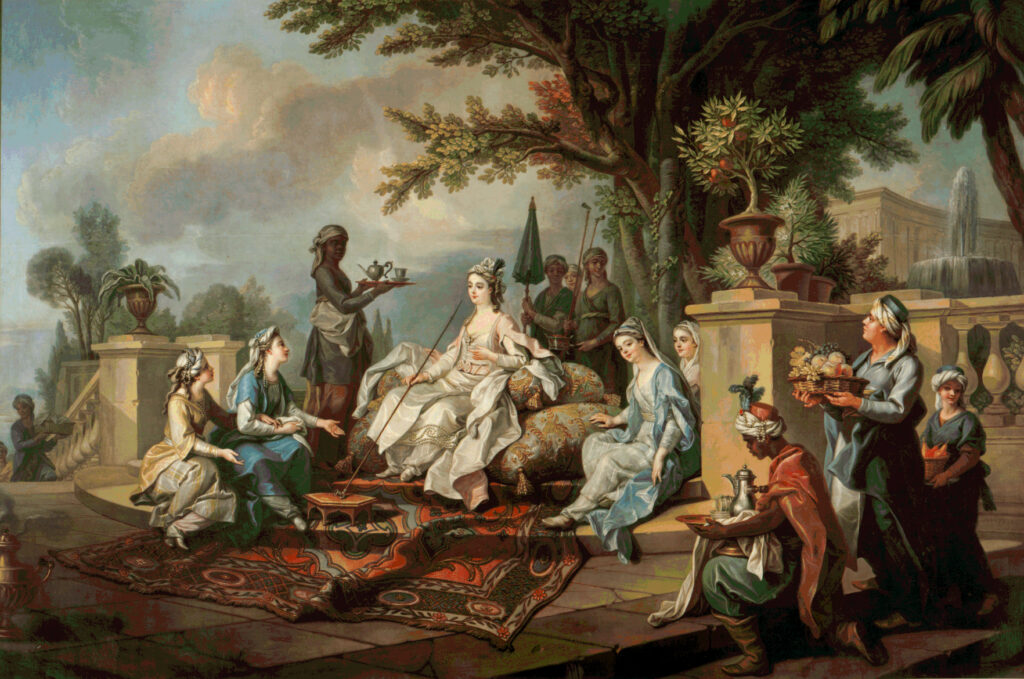
1773, oil on canvas, 3.60 x 5.19 m
Nice, Jules Chéret Fine Arts Museum, N.Mba 2322
Filling of the Louvre in 1927
© Ville de Nice
Within the framework of the Amidex-IRV Utpictura18 project, leads by the Aix-Marseille University, this painting was selected to produce a virtual gallery linking text and picture. You can refer to it by clicking here.
Francesco Cozza, Cléopâtre taking her own life
This painting is currently on deposit at the Art Museum of Nantes within the framework of the following renovation the Fine Arts Museum of Nice.
Cleopatra, Queen of Egypt, is about to commit suicide
with an asp, a snake with deadly venom.
She chose death rather than be captured and humiliated by the Romans following the defeat of her ally and
lover, General Mark Antony, in 31 BC.
The heroine is depicted in a moment of great vulnerability
of great vulnerability and courage, a quality
considered eminently masculine at the time.
Cleopatra is in fact part of the theme of
theme of ‘illustrious’ or ‘heroic’ women
which developed strongly during the
of the 17th century, featuring heroines from
heroines (Lucretia), biblical heroines (Judith) and mythological heroines
mythological heroines (Circe).
The light, dramatically underlining the shimmering reflections of the fabric, but also the sculptural treatment of the sculptural treatment of the pyramidal composition
characteristic of the Baroque aesthetic.
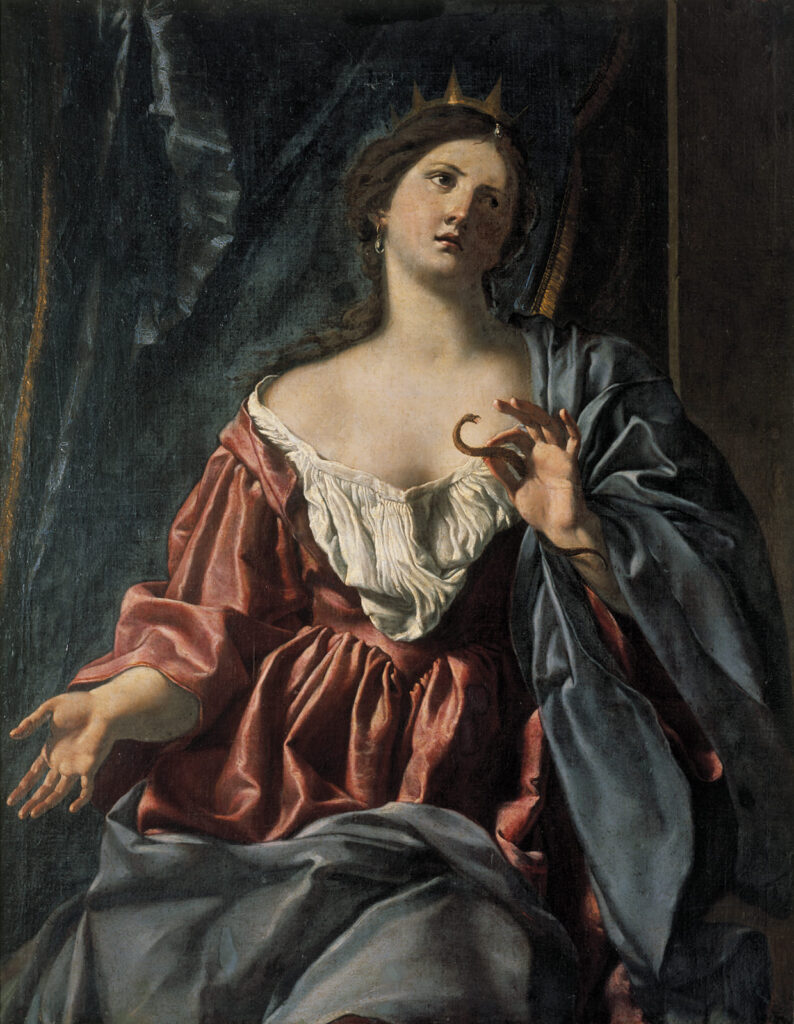
17th century, oil on canvas, 126 x 98 cm
Nice, Jules Chéret Fine Arts Museum, N.MBA 69
Donation of Auguste Carlone in 1875
© François Fernandez
Atelier de Jean II Brueghel, Flowers and goldsmith’s objects
This painting is currently on deposit at the Art Museum of Nantes within the framework of the following renovation the Fine Arts Museum of Nice.
A bouquet of roses and peonies in a metalwork vase
metal vase is in the foreground of this still life.
Nearby, a small squirrel nibbles a hazelnut, enlivening the composition. To the right, slightly set back, a tazza, a gilded bronze bowl a gilded bronze bowl, supports an arrangement an arrangement of red, orange and white flowers on which a butterfly alights.
The shapes stand out against a dark background, while the light illuminates the overhanging scene, accentuating the
the details of the objects.
Jan II Brueghel was trained by his father Brueghel
known as ‘de Velours’. The family studio enjoyed great success the sale of small flower paintings.
Like Osias Beert and Frans Snyders, Jan’s son
did not hesitate to use the formulas tried and tested
tried and tested by his father: finely executed
finely executed and disturbed by the presence
disturbed by the presence of animals.
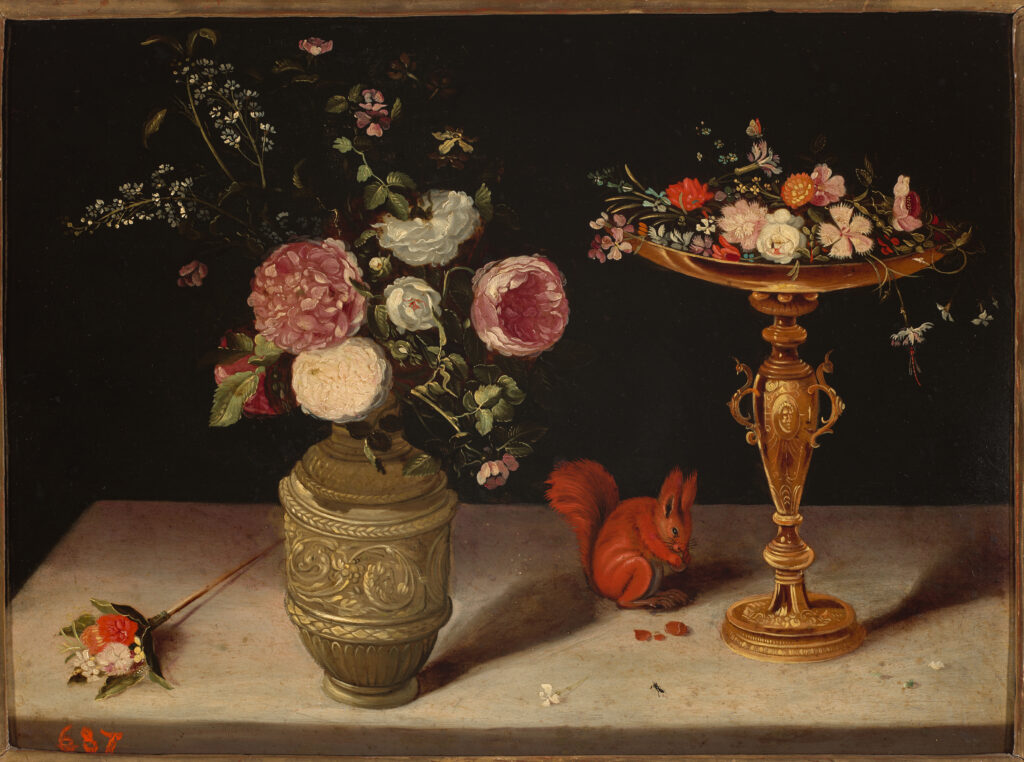
Circa 1620, oil on canvas, 22x 30 cm
Nice, Jules Chéret Fine Arts Museum, N.MBA 687
Legacy of Fanny Trachel in 1903
© François Fernandez
Hendrick Van Somer, David holding Goliath’s head
This painting is currently on deposit at the Art Museum of Nantes within the framework of the following renovation the Fine Arts Museum of Nice.
David, a young Hebrew shepherd, has just confronted the
Philistine giant Goliath. Described as a formidable
warrior in the Old Testament, he was struck down
by a single stone from David’s slingshot.
His decapitated head bears his mortal mark.
Everyday details, such as the braces of the costume
braces or the rabbit-skin headdress, and the realism of the physiognomies and the prominent veins
are typical of the artist’s native Flanders.
The atmosphere of the scene is dramatised by a chiaroscuro inherited from the Caravaggesque movement. The artist decided to settled for 15 years in Naples, then under Spanish rule, where he became a pupil of
Jusepe de Ribera, a brilliant Caravaggesque painter.
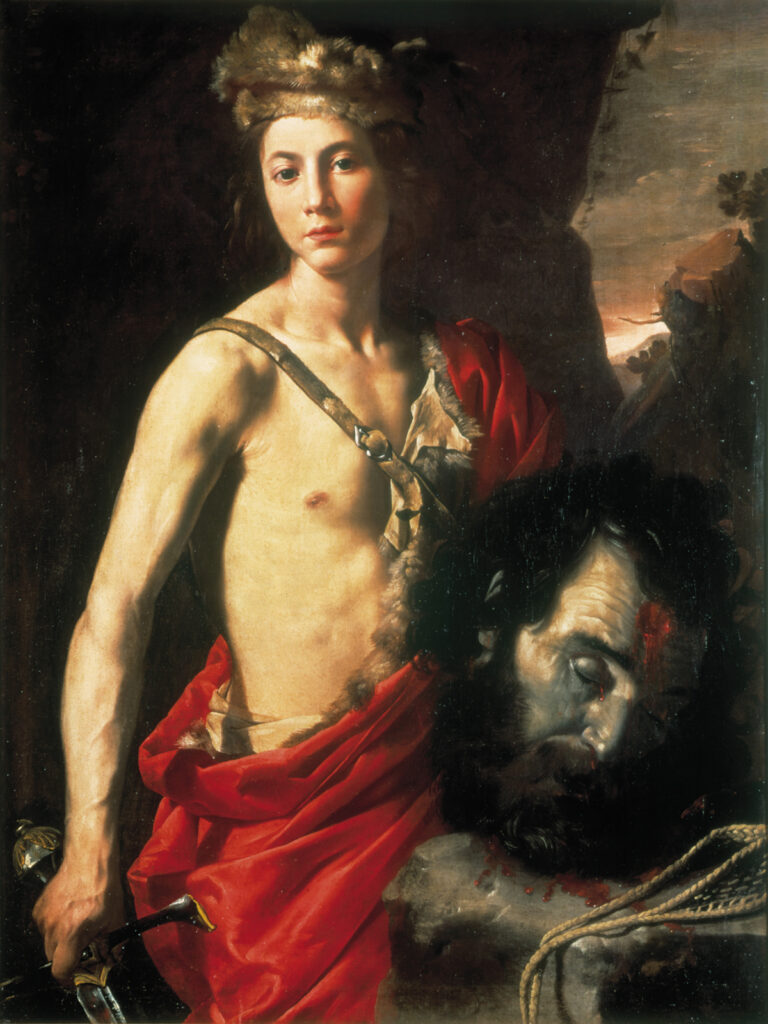
1615, oil on canvas, 100 x 74 cm
Nice, Jules Chéret Fine Arts Museum, N.MBA 5772
Buying of the City of Nice in 1978
©François Fernandez