
Jules Chéret, Luncheon on the Grass
On display
Masterpiece of the museum’s collection, Chéret places this painting within the iconographic tradition of luncheons on the grass, forty years after the scandal caused by Édouard Manet’s eponymous work, preserved at the Musée d’Orsay. However, in this painting, there is no provocation from the artist, but a genuine reference to the French rococo painting and its atmosphere of gallant festivities, illustrated in the 18th century by artists like Fragonard, Boucher, and Watteau.
True to his luminous chromatic range and swirling treatment of space, the canvas is built around a dynamic where everything becomes candid joy of living and movement. It is worth noting that originally, this painting is a cartoon, that is, a preparatory work, for a tapestry commissioned by the industrialist and collector Maurice Fenaille. This was executed in his weaving workshop in Paris, directed by Ulysse Gauzy.

1904, oil on canvas, 230 x 90 cm
Nice, Jules Chéret Fine Arts Museum, N.Mba 2280
Donated by Mr. Maurice Fenaille in 1927 © Michel Graniou
Gustave-Adolphe Mossa, She
Not on display
Symbolic of Mossa’s symbolist period, “She” emerges as the icon of the Femme fatale. A saintly figure gone astray, she is haloed with a Latin inscription by Juvenal (late 1st-early 2nd century): “This is my command, let my will take the place of reason,” a sacrilegious allusion to the Lord’s Prayer.
Resembling a diabolical doll exuding eroticism and death, she is crowned with birds of prey and human skulls and wears a funereal necklace composed of various weapons. In her provocative nudity, she dominates a mound of male corpses that she crushes with her fingers and flesh. The threatening sky exacerbates the drama of the scene.
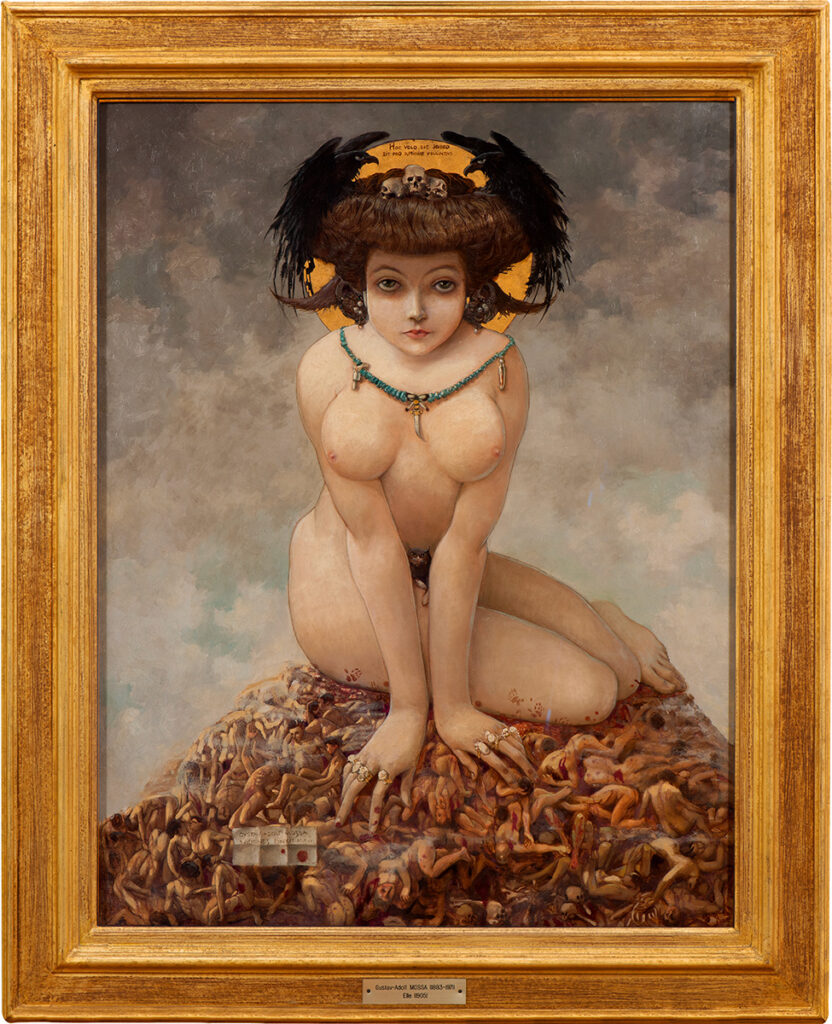
1905, oil on canvas, 80 x 63 cm
Nice, Jules Chéret Fine Arts Museum, N.Mba 3268
Bequeathed by Mr. Gustave-Adolphe Mossa in 1972 © Ville de Nice
Charles Camoin, Terrace in Saint-Tropez
On display
Originally from Marseille, Camoin trained in the studio of the symbolist painter Gustave Moreau, alongside Henri Matisse, Henri Manguin, and Albert Marquet. He joined them in the fauvist adventure as early as 1903. Executed in Saint-Tropez, where he settled after World War I, this work pays homage to the Mediterranean luminosity through an exaltation of color: the contrast of red tiles with the blue-green landscape, a dress adorned with vibrant red and green floral motifs against a white background.
The model, named Nicole, is the daughter of the Serbian painter Marko Čelebonović. Barefoot, with a tanned complexion, comfortably seated facing the sea, she embodies the new population that settled on the shores of the Mediterranean from the 19th century onwards to enjoy the mild climate and, for artists, its incomparable light.
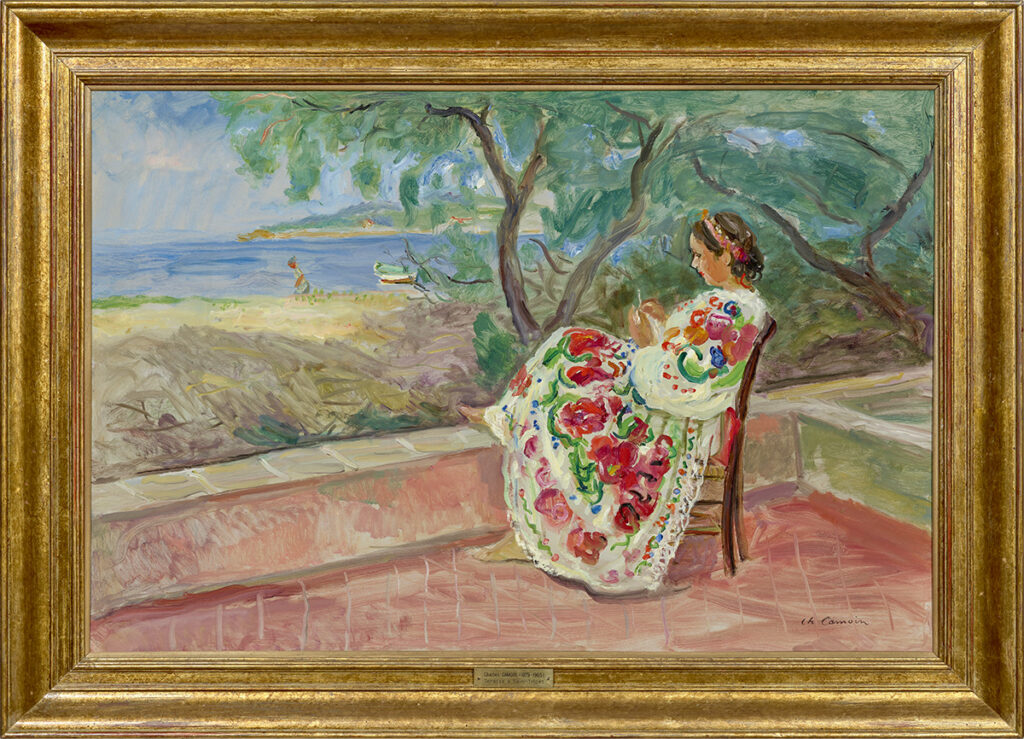
1937, oil on paper, 74 x 110 cm
Nice, Jules Chéret Museum of Fine Arts, N.Mba 2816
On loan from F.N.A.C since 1952 © Ville de Nice
Raoul Dufy, Composition with Chrysanthemums on Black Background
Not on display
Raoul Dufy contributes to the renewal of fashion and decorative arts through the creation of textiles for clothing and furnishings. He works both for haute couture and for industrial fabric production.
Flowers emerge as emblems of his printed work and give him the freedom to repeat patterns, such as these chrysanthemums arranged in a staggered pattern. The yellow, fuchsia pink, gray, and green of these flowers come alive against a sumptuous black background, giving the illusion of a fireworks display.
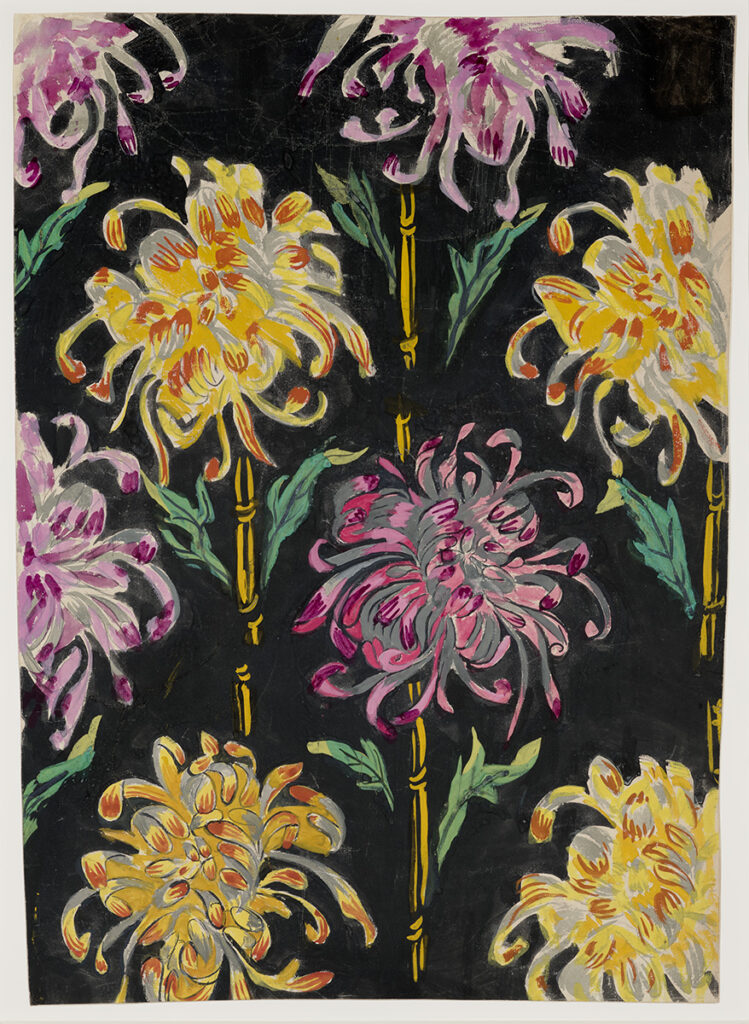
circa 1924, charcoal and gouache on laid paper, 59 x 43.3 cm
Nice, Jules Chéret Fine Arts Museum, N.Mba 6129
Purchased by the City of Nice in 1986 © François Fernandez