
Discover a curated selection of works from our collection related to the exhibition “Maurice Denis, the 1920s : The Splendour of the South”.
Step in the history of the works listening the audio and letting yourself be guided.
Kees Van Dongen
Portrait of the Haitian Ambassador, Auguste Casseus
On display
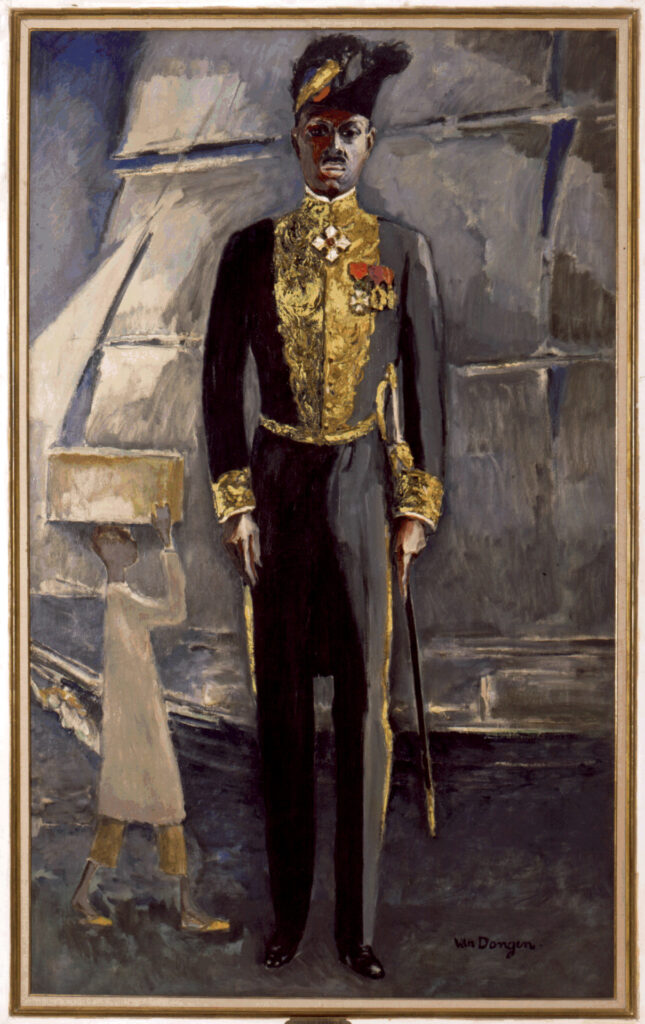
Portrait of the Haitian Ambassador, Auguste Casseus
Around 1923-1924
Oil on canvas
Nice, Fine Arts Museum Jules Chéret, N.Mba 3038
Donation of Kees Van Dongen in 1960
© Ville de Nice
Born in the Netherlands, Kees Van Dongen was active in France, where he settled in 1899. After starting out as an illustrator, he made a name for himself as a painter and enjoyed such success that he was accepted into Parisian high society between the two world wars. At the time he painted this canvas, Van Dongen was an artist at the height of his fame, whose society portraits – particularly of women – were highly sought after by the bourgeoisie. This monumental, solemn painting expresses the dignity of its subject, the Haitian ambassador. He stands upright, looking directly at the viewer, in the centre of the canvas, which he occupies from top to bottom. Depicting him in his official uniform, wearing a sabre and medals, the painting affirms his social status. Behind this conventional genre, however, one can discern the painter’s taste for experimentation with highly saturated colour, reminiscent of his Fauvist explorations at the beginning of the century. This work has recently undergone extensive restoration of its paint layer in order to be exhibited.
Raoul Dufy
Homage to Claude Lorrain
On display
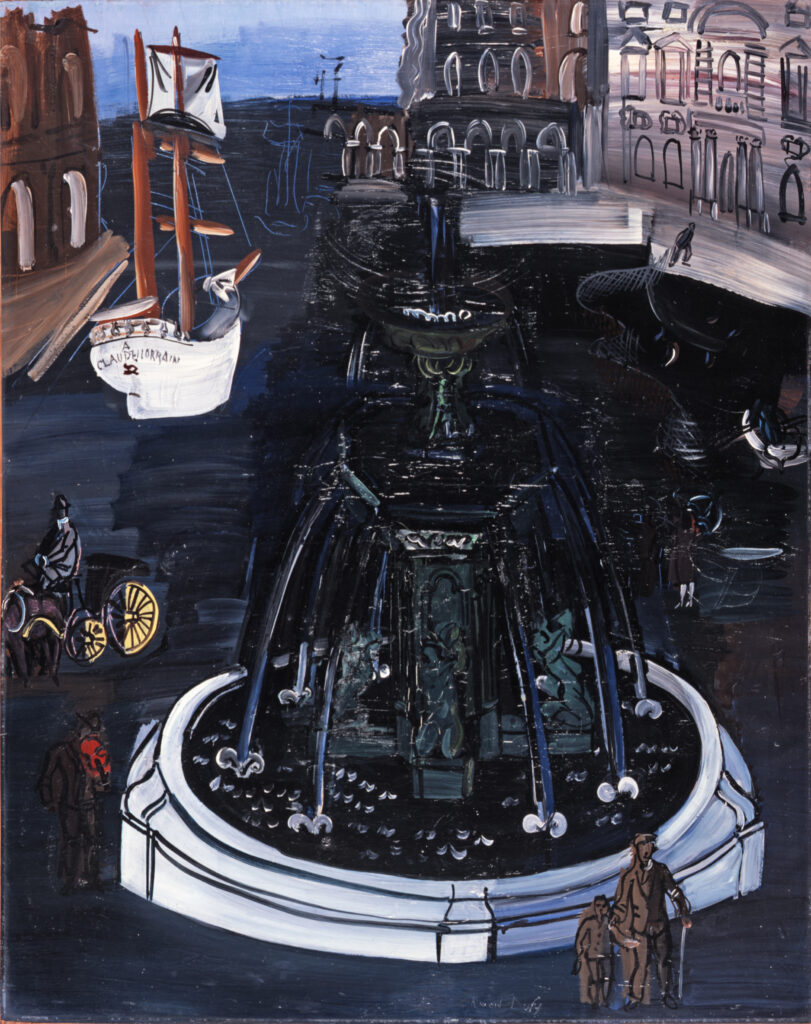
Homage to Claude Lorrain
1927
Oil on canvas
Nice, Fine Arts Museum Jules Chéret, N.Mba 5606
Legacy of Emilienne Dufy in 1962
© Muriel Anssens – Ville de Nice
From 1917 to 1929, Raoul Dufy produced a series of watercolours and paintings in tribute to the painter Claude Gellée, known as Le Lorrain (1600–1682). These works reflect a personal interpretation of the master’s aesthetic. Dufy offers us his conception of a recomposed landscape, an imaginary and idealised evocation of a site. From Le Lorrain’s art, he retains a composition structured according to the proportions of the golden ratio, with an opening towards the sea and the representation of classical architecture. In the foreground of the painting opposite is the fountain with baroque tritons in the town of Hyères, while the Colosseum in Rome can be glimpsed in the background on the left. Other motifs that the painter was fond of feature in this series: the sailing ship, the steamboat and the horse-drawn carriage.
This canvas is unusual in that it is flooded with a dominant black colour. It expresses the intensity of a light so incandescent that it seems to have burned the canvas itself.
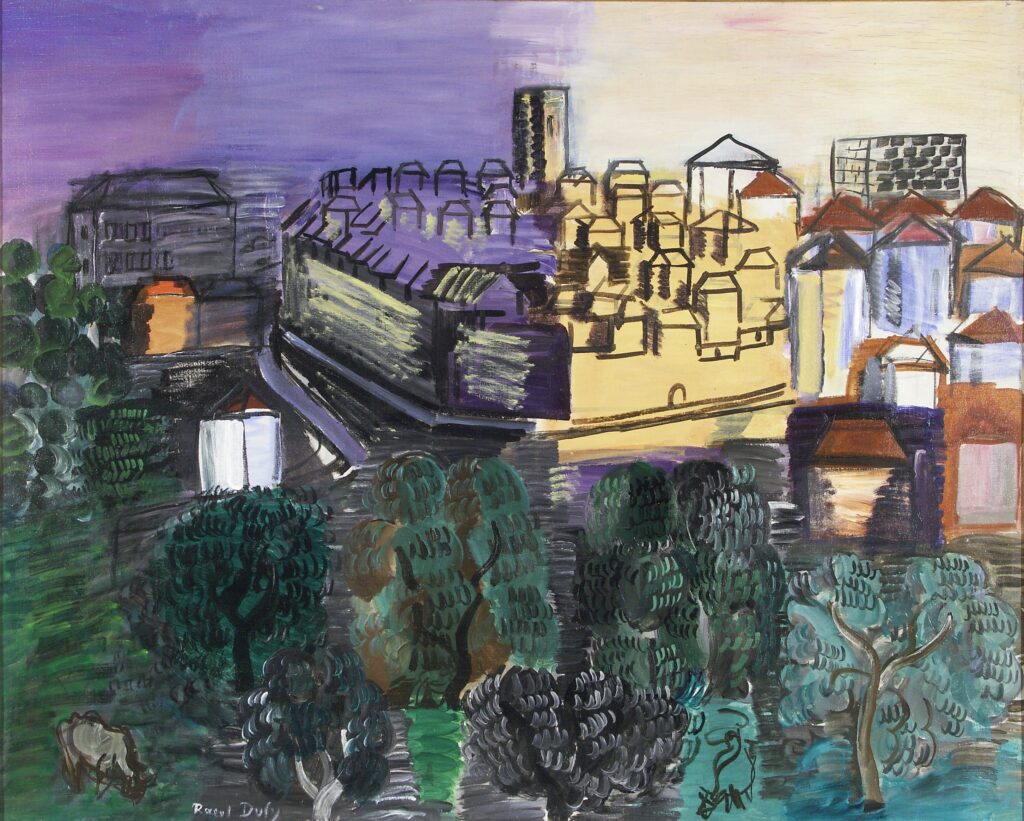
Raoul Dufy, Vence
On display
1919-1920
Oil on canvas
Nice, Fine Arts Museum Jules Chéret, N.Mba 5604
Legacy of Mme Émilienne Dufy in 1962
© Muriel Anssens – Ville de Nice
During his stays in Vence between 1919 and 1922, Raoul Dufy produced numerous views of the medieval village, surrounded at the time by centuries-old olive trees. He retained only the essential elements of the landscape, which he translated into a vocabulary of visual symbols: olive trees and vines were evoked by a succession of arabesques and curls, roofs were covered with undulating lines representing tiles, and tree foliage was depicted as free and dynamic commas.
It was in Vence that Dufy began to dissociate colour from the contours of forms. Large areas of ochre and mauve colour punctuate the surface of the painting, evoking both night and day. But it is also the dazzling light of the South of France that Dufy seeks to render with broad black strokes that convey its intensity. For the artist, black is light pushed to its climax.
Raoul Dufy
The Casino on the Jetée-Promenade with two horse-drawn carriages
On display
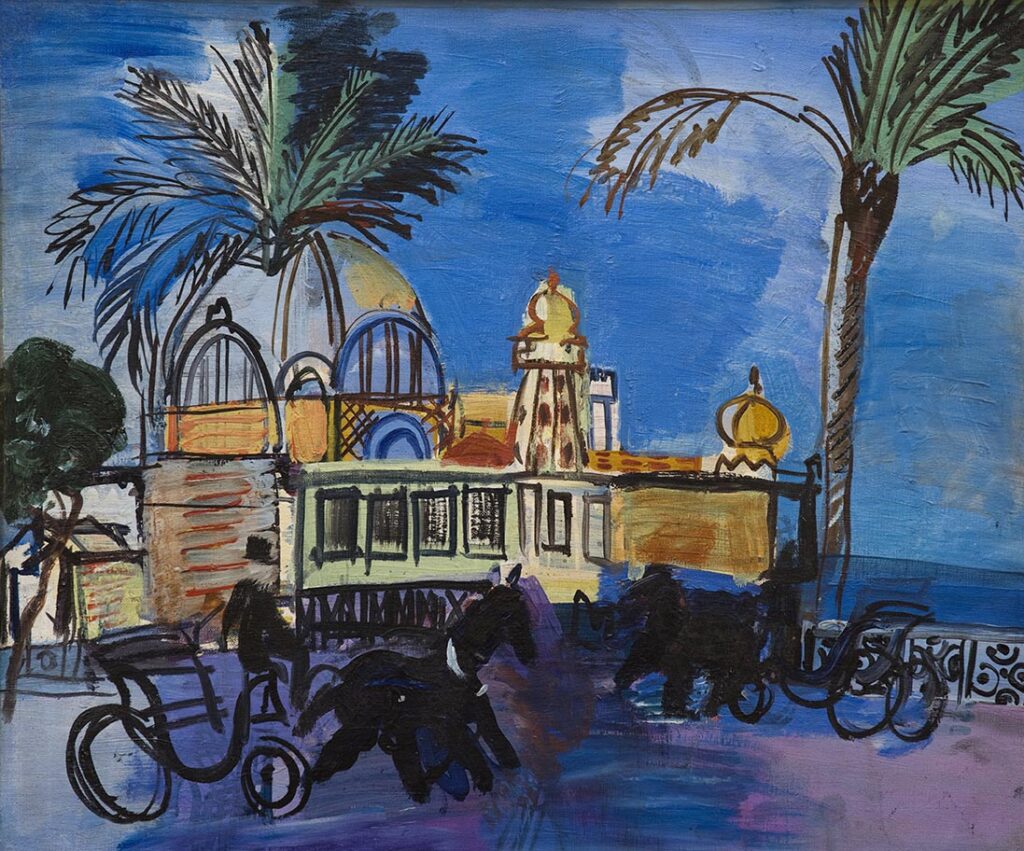
The casino on the Jetée-Promenade with two horse-drawn carriages
1927
Oil on canvas
Nice, Museum of Fine Arts Jules Chéret, N.Mba 3002
Donation of Mme Emilienne Dufy in 1955
© Muriel Anssens – Ville de Nice
In most of Raoul Dufy’s views of Nice, palm trees leave a decorative imprint on the sky with their outstretched branches. He also liked to depict the curve of the Promenade des Anglais, which he brought to life with strollers, horse-drawn carriages and cars. The Casino de la Jetée-Promenade, with its eclectic oriental style, fascinated Dufy, who depicted it from every angle, from near and far, by day and by night, in the background or as the central subject of his composition. Although it was demolished in 1944, he continued to feature it in his paintings, as evidenced by the version painted in 1950, shown here.
Raoul Dufy
Still life with fish and fruits
On display
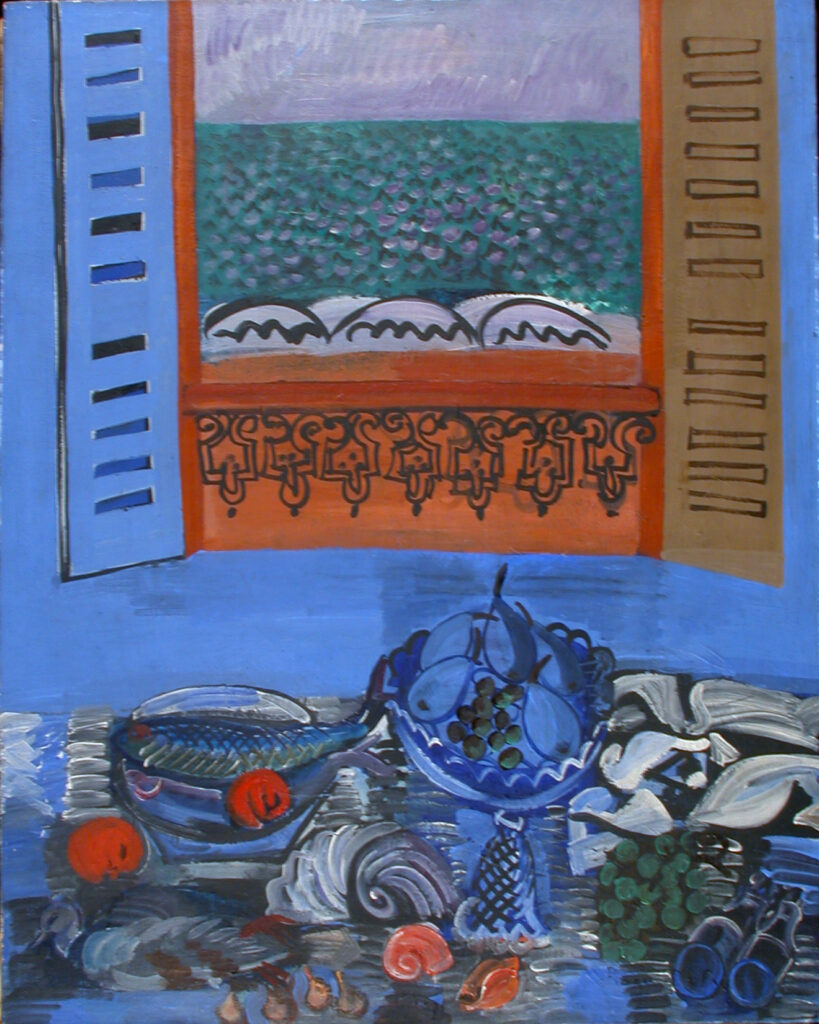
Still life with fish and fruits
Between 1920 and 1922
Oil on canvas
Nice, Fine Arts Museum Jules Chéret, N.Mba 5605
legacy of Emilienne Dufy in 1962
© Muriel Anssens – Ville de Nice
Two dishes containing fish and fruit lie on a table, accompanied by various objects including shells, a bunch of grapes and two bottles. The background, a window opening onto the sea, guides the viewer’s gaze far into the distance. This painting was executed in Sainte-Adresse, Normandy. The painter adopts a different palette from the one he uses on the French Riviera, with darker blues and a grey sky that reflect the Normandy climate.
Dufy produced numerous still lifes during his career, initially under the influence of Cézanne, who inspired him to break free from the traditional rules of perspective. This influence is evident in the treatment of the fish dish and the bowl of pears, which appear to be viewed from above, while the window is seen from the front. The artist still confined colour to the contours of objects, unlike in his later work, which separated the two.
Raoul Dufy, Marseille Port
On display
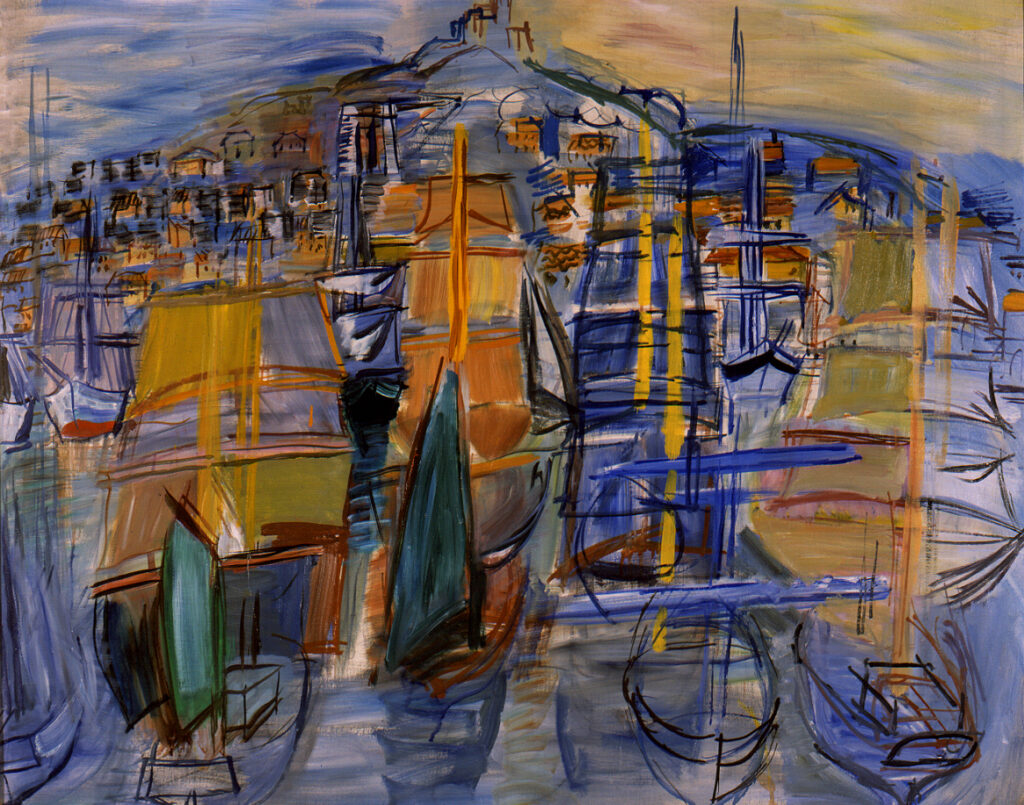
Marseille Port
Between 1950 and 1952
Oil on canvas
Nice, Museum of Fine Arts Jules Chéret, N.Mba 5625
Legacy of Emilienne Dufy in 1962
© Muriel Anssens – Ville de Nice
Raoul Dufy had a genuine fascination with the sea, which he constantly evoked in his work. Born in Le Havre but a regular visitor to the South of France, the artist spent his life moving between the English Channel and the Mediterranean. His numerous views of bays, beaches and ports, as well as his numerous scenes of regattas and rowing races, testify to his equal interest in seascapes and nautical activities.
His works are subject to the progressive fusion of his imagination with observed reality. The sea is used as a backdrop against which motifs gleaned here and there are hung: sailing boats, steamboats, flags, rowers and bathers. Dufy even chose an aerial viewpoint that allowed him to exaggerate the curve of the horizon and merge the sky with the expanse of the sea, in a variation of blues ranging from cerulean to cobalt. The waves are represented by sharp, sparkling accents that become small triangles over time.
Moïse Kisling
River Port
On display
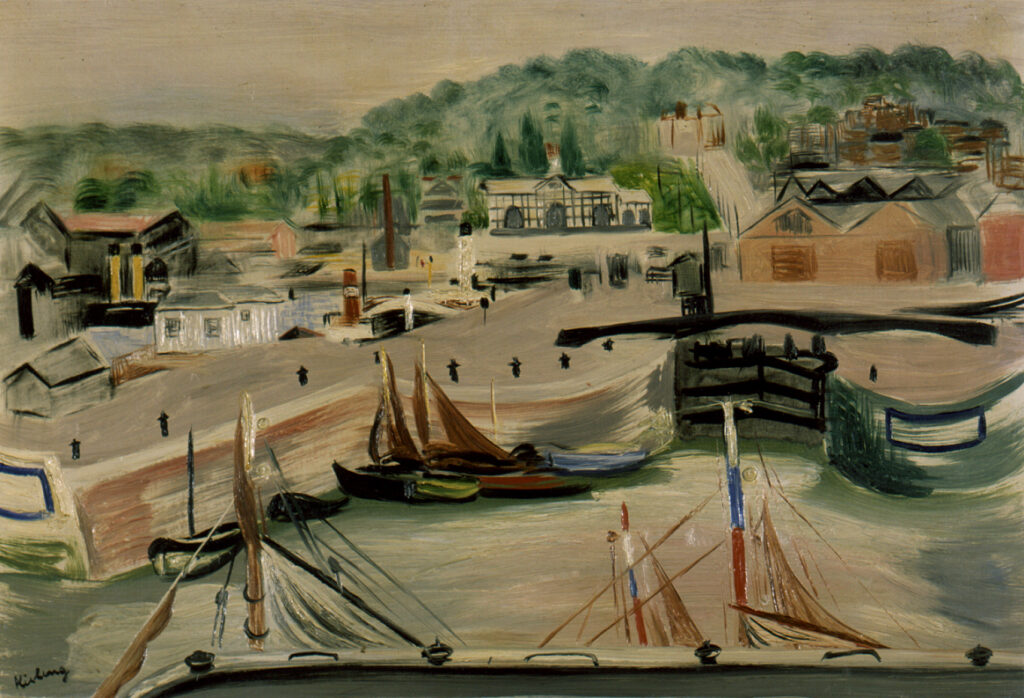
River Port
20th century
Oil on canvas
Nice, Museum of Fine Arts Jules Chéret, N.Mba 1999.1.2
Legacy of Ethel Messiah in 1999
© Ville de Nice
In the 1910s, Moïse Kisling began spending regular periods in the south of France, particularly in Marseille and Saint-Tropez. His landscapes took on new significance after his first visit in 1917. This view of the harbour, seen from the quay, highlights the masts of the boats visible in the foreground and the water, whose reflections are rendered in white and green with broad brushstrokes that leave the brushwork visible. The vanishing lines of the painting converge towards the lock. Its black colour contrasts with the lighter tones of the docks and houses that make up the rest of the composition
Henri Lebasque
Pastoral landscape
On display
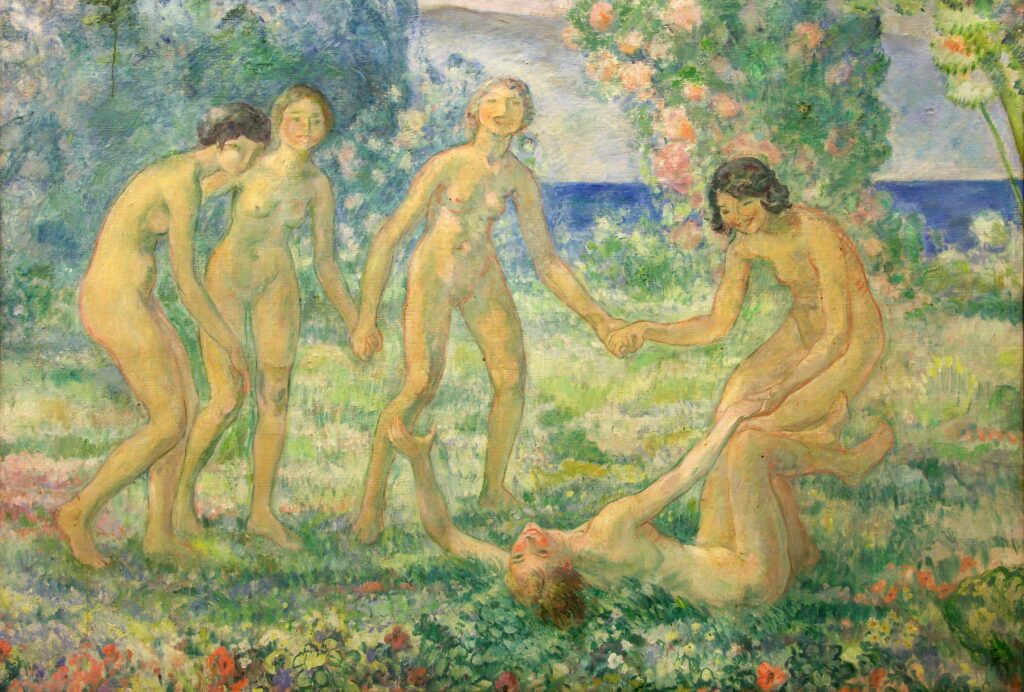
Pastoral Landscape
20th century
Oil on canvas
Nice, Fine Arts Museum Jules Chéret, D 3046
State filling in 1955
© Ville de Nice
This painting offers an interpretation of the theme of the Golden Age, explored since ancient times by authors such as Hesiod. As the first age of humanity, the Golden Age embodies a fantasised paradise that has been irrevocably lost. The subject enjoyed great critical popularity in painting from the Renaissance onwards thanks to the rediscovery of ancient texts, before experiencing a revival in the 19th century. It then came to symbolise harmony and communion with nature, in a historical context marked by numerous political crises and growing industrialisation. This painting uses the iconography of the circle of harmony, formed by the circle of naked dancers. Their smiling expressions and the bright colours of the natural world around them evoke a vision of Arcadia. This theme is common in Denis’s iconography, and he used it in several preparatory sketches for paintings intended to decorate the Prince of Wagram’s mansion in 1910.
Pierre Bonnard
Open window on the Seine at Vernonnet
On display
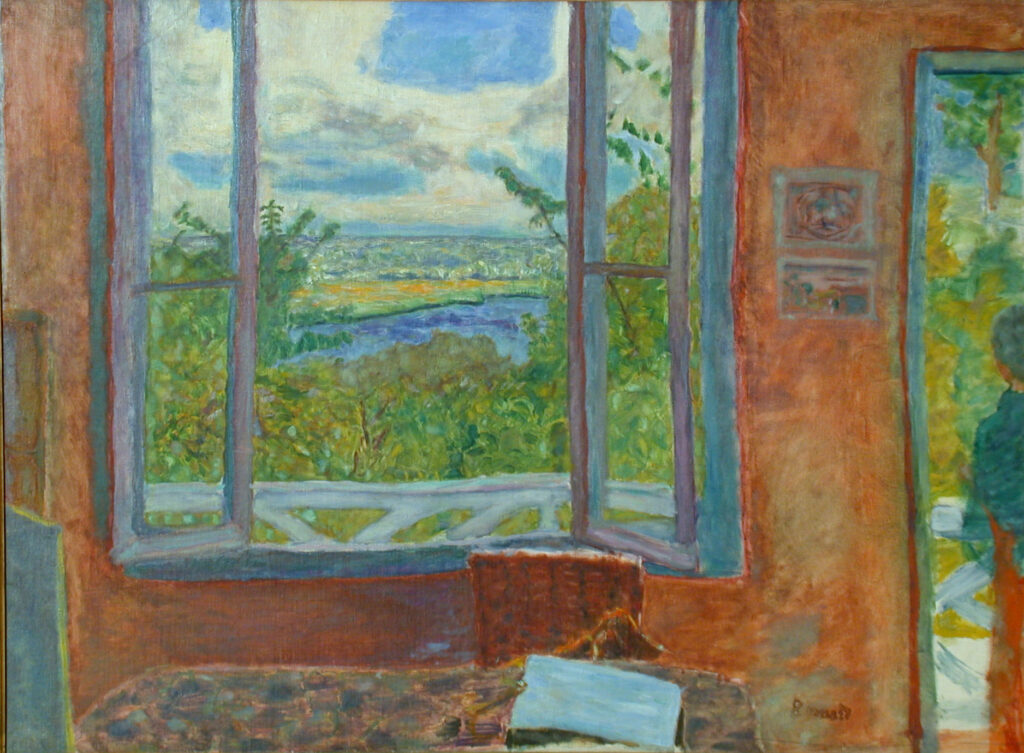
Open window on the Seine at Vernonnet
1912
Oil on canvas
Nice, Fine Arts Museum Jules Chéret, N.Mba 6051
Buying of the City of Nice in 1982
© Ville de Nice
This 1912 painting was created from the first floor of Bonnard’s house in Vernonnet, Normandy. He was particularly interested in the window as a boundary between his private world and the natural world outside. The blue and green hues that convey the cold luminosity of the landscape contrast with the orange tones of the room, which warm the atmosphere. Here, the window acts as an interface between the domestic, organised world in the foreground and the disorder of the vegetation outside, which are juxtaposed. Thanks to the window, the enclosed interior opens onto the infinite horizon.
The surprising composition reveals a silhouette in the doorway at the edge of the work. It gives the observer, whose gaze is drawn to the landscape, the impression of entering the room and discovering the surprising presence of a figure.
Pierre Bonnard was a close friend of Maurice Denis. After several stays in the South of France, Bonnard bought a house in Le Cannet in 1922, from where he corresponded with Denis, who was then living in Brittany. This new hanging of the collections is a rare opportunity to admire this work, which spends a lot of time outside the Museum of Fine Arts. It is often loaned to other institutions for temporary exhibitions.
Louis Valtat
On the beach
On display
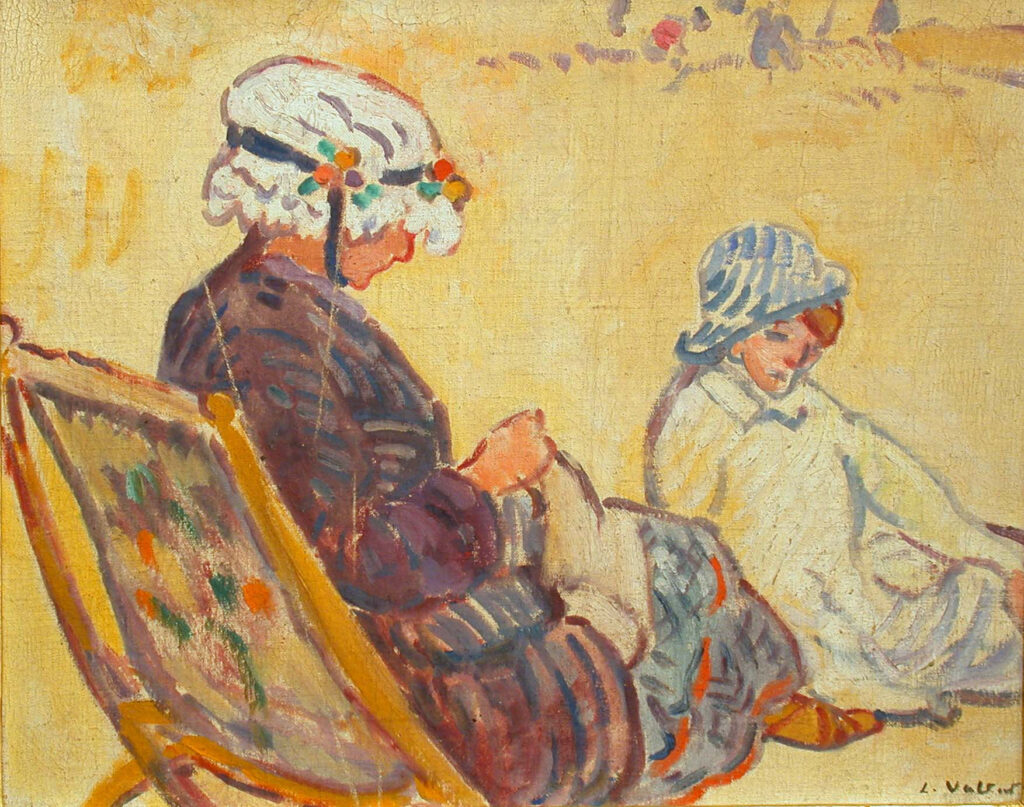
On the beach
Around 1910
Oil on canvas
Nice, Fine Arts Museum Jules Chéret, N.Mba 1999.1.4
Legacy of Ethel Messiah in 1999
© Ville de Nice
A woman sitting on a deckchair and a young girl stand out against the light yellow sand, the scene immersed in the golden light characteristic of the landscapes of the south of France. The sea is not visible, its presence only suggested by the title. The motif of the beach scene, dear to artists who travel to the South of France, is perfectly illustrated by this work. The location of this scene is unknown, but it could have been painted on the Côte d’Azur, in Anthéor or Agay, where Louis Valtat spent the winter months. Maurice Denis visited him during his first trip to Provence in 1906.
Félix Valloton
Landscape around Perugia
On display
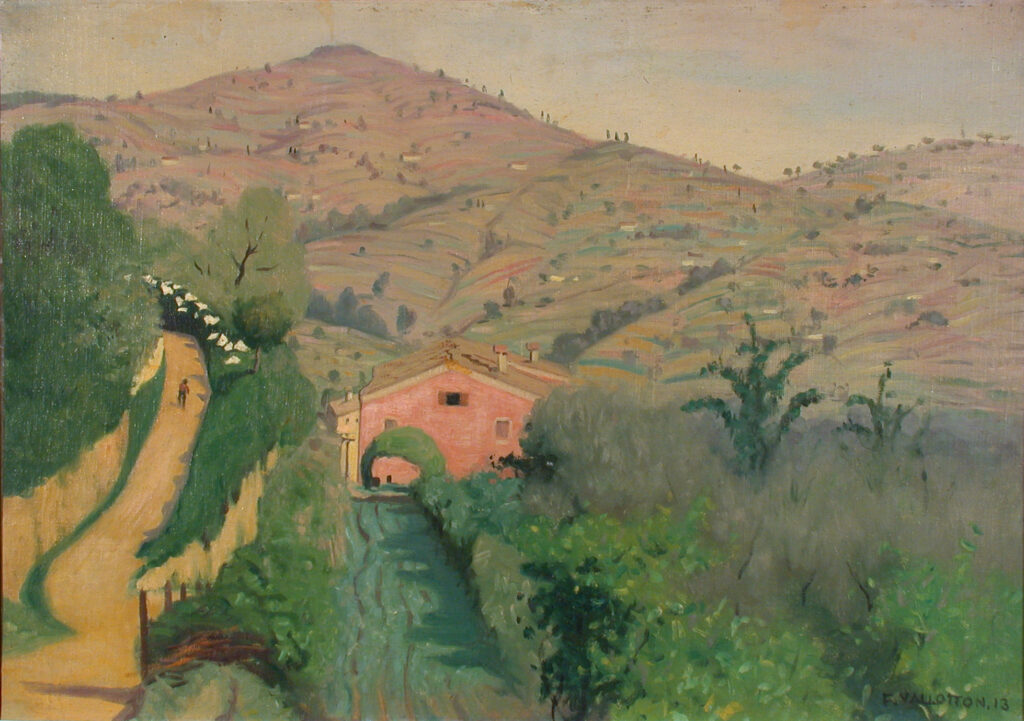
Landscape around Perugia
1913
Oil on canvas
Nice, Fine Arts Museum Jules Chéret, AM 3199
Filling of the Orsay Museum in 1954
© Ville de Nice
Félix Vallotton was a close friend of Maurice Denis. Together with other painters, including Ker-Xavier Roussel, who accompanied Maurice Denis to the South in 1906, they formed the Nabis group, within which Vallotton and Denis were nicknamed ‘the foreign Nabi’ (Vallotton was Swiss) and ‘the Nabi with beautiful icons’, in reference to the Christian faith evident in Denis’s work. Formed in the early 1890s, the group no longer existed when this painting was created. However, the works painted by Denis and Vallotton in the following decades shared a common interest in the South, its light and its landscapes. Although he is best known today for his woodcuts, Vallotton was first and foremost a painter and produced numerous landscape views, in the Paris region and Normandy, but also in Cagnes, where he bought a plot of land in 1924. In 1890, he discovered Italy, where he returned many times. He travelled to Rome and Perugia in particular during his 1913 trip, when this painting was produced. A land of artists par excellence, Italy attracted many French painters who travelled there on study trips, often stopping off in Cannes, Nice or Menton.
Charles Camoin
Balcony in Saint-Tropez
On display
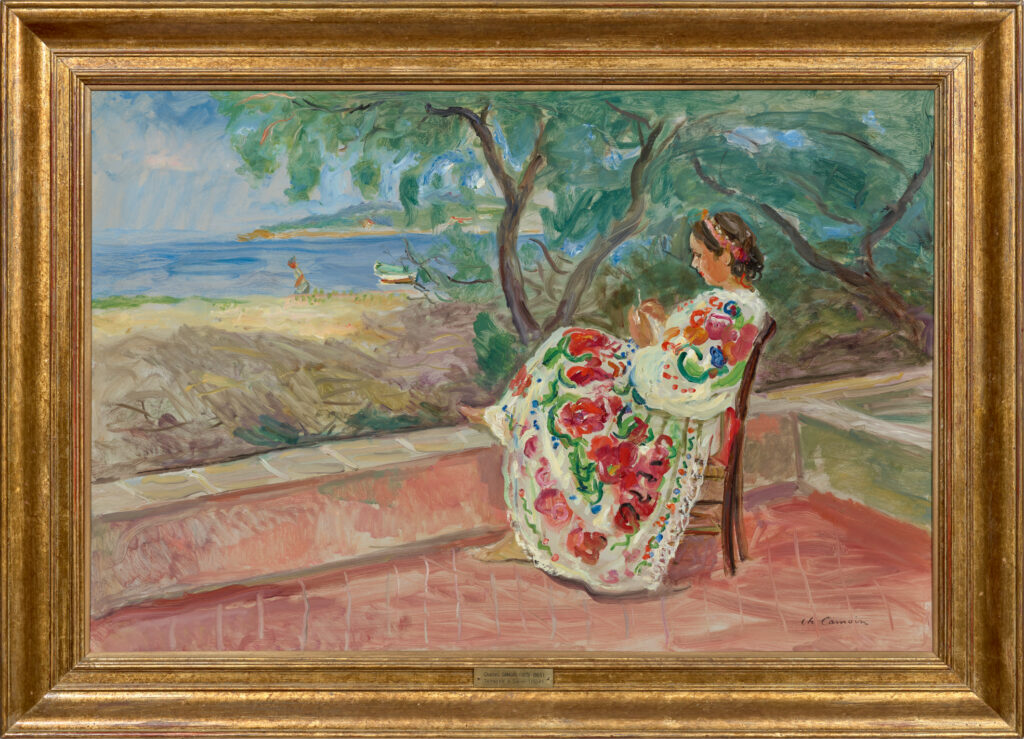
Balcony in Saint-Tropez
1937
Oil on canvas
Nice, Fine Arts Museum Jules Chéret, FNAC 15222
Filling of the National Contemporary Arts Funds in 1952
© François Fernandez
Like his contemporaries, Charles Camoin was fascinated by the southern sun, which he sought out all around the Mediterranean during stays in Provence, Andalusia and Morocco. At the 1905 Salon d’Automne, critics praised his sense of light and colour.
Like Maurice Denis, he greatly admired Paul Cézanne. In 1901, while doing his military service, he took advantage of his posting to the barracks in Aix-en-Provence to visit the master, with whom he remained in contact through visits and letters until the latter’s death in 1906.
On the French Riviera, the painter also frequented his friends Pierre Bonnard and Henri Lebasque. Camoin was one of the painters most deeply embedded in the artistic social networks of the South of France. With Henri Matisse, a former classmate from the École Nationale des Beaux-Arts who had been living in Nice since 1917, he visited Auguste Renoir in Cagnes-sur-Mer in 1918.
Particularly attracted to Saint-Tropez, he bought a house there in 1921 for a few years and produced numerous paintings depicting the town, the hinterland and his loved ones. This canvas is characteristic of this production, both in terms of its subject matter and its choice of colours.
The model, named Nicole, is the daughter of Serbian painter Marko Čelebonović. Barefoot, tanned, comfortably seated facing the sea, she embodies the new population that settled on the shores of the Mediterranean in the 19th century to enjoy the mild climate and, for artists, its incomparable light.
Moïse Kisling
Portrait of a young girl
On display
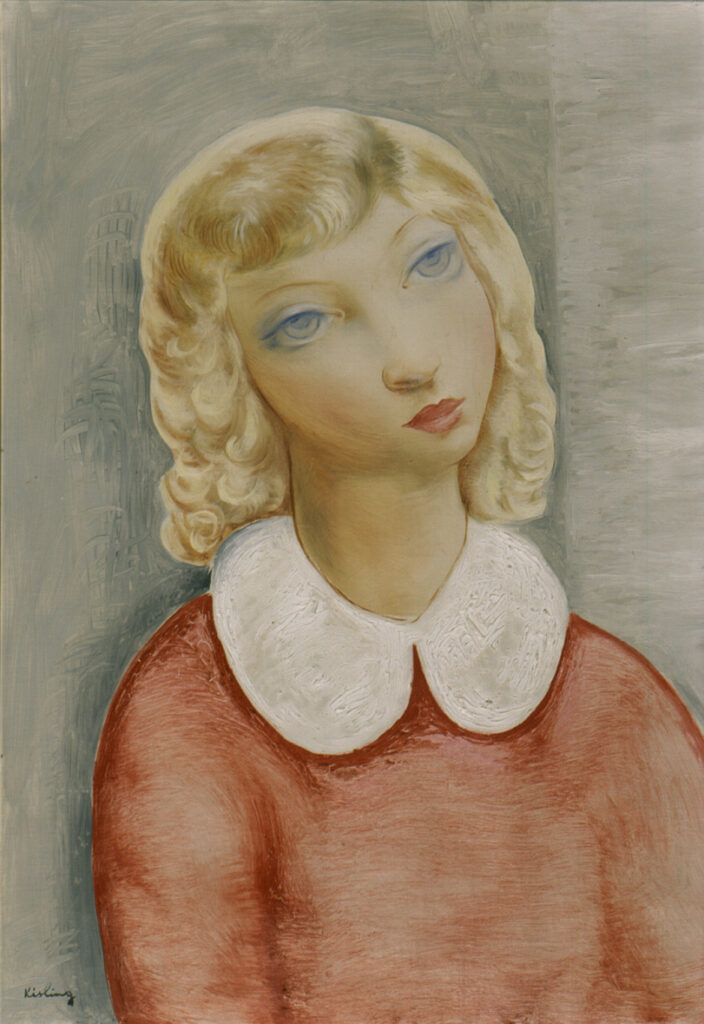
Portrait of a young girl
20th century
Oil on canvas
Nice, Fine Arts Museum Jules Chéret, N.Mba 1999.1.1
Legacy of Ethel Messiah in 1999
© Ville de Nice
Born in Poland, Moïse Kisling first arrived in France in 1910 thanks to the influence of Joseph Pankiewicz, his teacher at the Academy of Fine Arts in Krakow, who was also a friend of Pierre Bonnard and Auguste Renoir. Initially settling in Montmartre, Kisling also spent time in the South of France – in Céret in 1912, then several times on the Côte d’Azur until he settled in Sanary-sur-Mer, where he died in 1953. Kisling, like Kees Van Dongen, is famous for the expressiveness of his portraits. The exaggeratedly large eyes of the young woman painted on this canvas, her gaze turned towards the sky, her head slightly tilted back, give her a dreamy air. This ethereal aspect is accentuated by the pastel palette of the background and face, with almost white blonde hair and clear blue eyes. The omnipresence of curved lines further adds to the impression of softness that emanates from the canvas
Marie Laurencin
Portrait of a young girl
On display
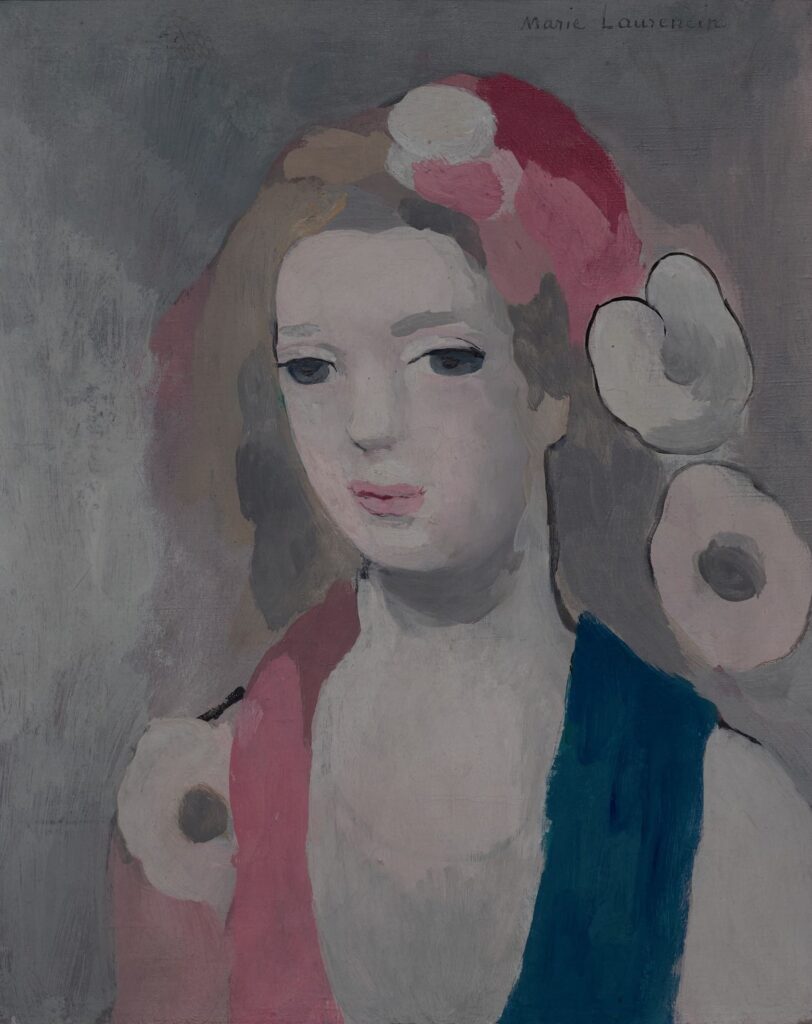
Portrait of a young girl
1950
Oil on canvas
Nice, Fine Arts Museum Jules Chéret, N.Mba 5599
Legacy of the Kahn family in 1976
© François Fernandez
This portrait is representative of Marie Laurencin’s style. She exhibited for the first time at the Salon des Indépendants in 1907 and frequented the ‘School of Paris’, a group of artists – mainly foreigners – working in the capital at the turn of the 20th century, when Paris was a major centre for modern artistic creation. The best-known representatives of this group were Pablo Picasso (1881-1973), Amedeo Modigliani (1884-1920) and Chaïm Soutine (1893-1943).
Married to a German, she spent the First World War in Barcelona. After the war, she returned to Paris and developed her style, using a visual vocabulary composed of slender female figures painted in pastel shades, with milky skin and wispy hair.
This portrait of a young girl displays all the characteristics that made her work famous, although the palette used here is a little brighter than usual in her work.
Edouard Vuillard, The Reading
On display
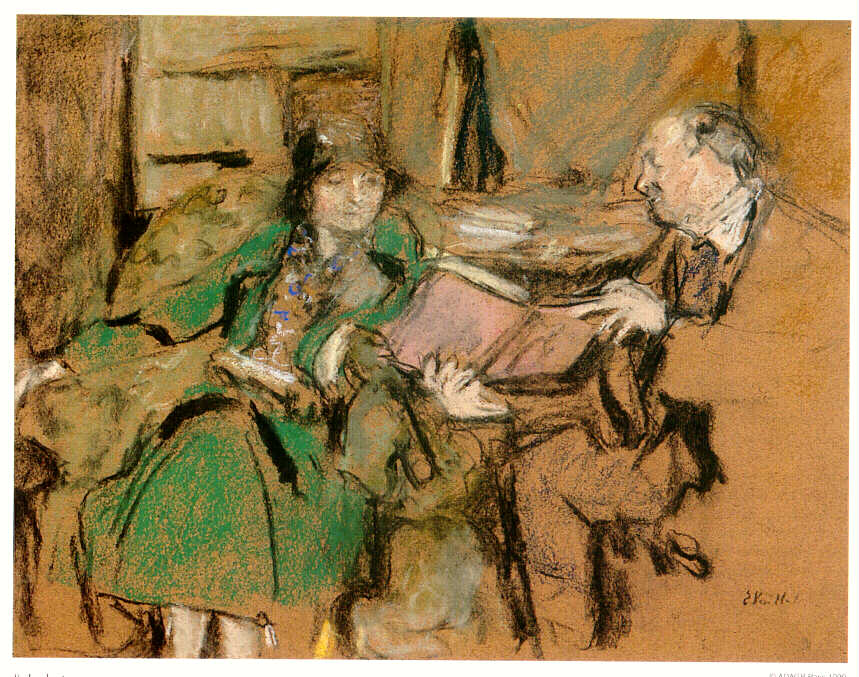
The Reading
1925
Pastel and charcoal on paper
Nice, Fine Arts Museum Jules Chéret, N.Mba 1999.1.3
Legacy of Ethel Messiah in 1999
© Ville de Nice
This interior draws the viewer into the intimacy of the characters depicted, captured as if on the instant by a quick stroke. The speed of execution afforded by the pastel technique, as opposed to oil painting, gives the impression of a living scene. The bibliophile Jacques Salomon, whose left arm and legs are barely sketched, shows a book to the artist’s niece, Annette. She is dressed in a dark green dress, the only area of colour in the composition. Renowned for his intimate domestic scenes, the painter truthfully captures a moment of everyday life here. While attending the Lycée Condorcet in Paris, Vuillard met Maurice Denis, Ker-Xavier Roussel (1867-1944) and Paul Sérusier (1864-1927), with whom he formed the Nabis group. The closeness between these artists was reinforced by family ties, as Ker-Xavier Roussel married Vuillard’s sister.