
Discover a commented selection of the works presented in the exhibition “Raoul Dufy, the miracle of the imagination”.
Boats in l’Estaque

1908
Huile sur toile
Nice, musée des Beaux-Arts Jules Chéret, N.Mba 5601
Legs de Mme Émilienne Dufy en 1962
© Muriel Anssens – Ville de Nice
The retrospective exhibition devoted to Paul Cézanne at the Salon d’Automne in 1907 was a real revelation for many avant-garde painters. Previously influenced by Fauvism and the colours of Henri Matisse, Raoul Dufy followed Cézanne’s example, spending part of the summer of 1908 at l’Estaque in the company of George Braque.
In Bateaux à l’Estaque, we find Cézanne’s directional, juxtaposed brushstrokes and ochre colours, in which both the architecture and the rocks blend. This period of stylistic borrowings was pivotal in the construction of Dufy’s singularity and the birth of his own universe.
The swing

Vers 1905-1906
Huile sur toile
Nice, musée des Beaux-Arts Jules Chéret, N.Mba 5600
Legs de Mme Émilienne Dufy en 1962
© Muriel Anssens – Ville de Nice
Observing the works of the so-called ‘Fauves’ at the Salon d’Automne in 1905 confirmed Dufy’s research into pure colour. This canvas bears witness to this, although the painter’s interest in a rigorous, geometric formal construction, inspired by Cézanne, was already apparent. In fact, he borrowed the oblique brushstroke from Cézanne.
Large tree in Sainte-Maxime

1942
Huile sur toile
Nice, musée des Beaux-Arts Jules Chéret, N.Mba 2852
Don de Mme Émilienne Dufy en 1955
© Muriel Anssens – Ville de Nice
The word ‘landscape’ never appears in the titles of Dufy’s works. He prefers to give the name of what, in the landscape, was the subject of his painting. Any unnecessary detail is omitted in order to characterise the very essence of the place captured at a given moment, which in this case is a parasol pine. He establishes a bold contrast where green and blue are omnipresent, linked by the ochre ground. This canvas is an undeniable tribute to the land of Provence and the incandescence of sunny afternoons.
The Baou of Saint-Jeannet

Vers 1925
Gouache sur papier
Nice, musée des Beaux-Arts Jules Chéret, N.Mba 2855
Legs de Mme Émilienne Dufy en 1962
© Muriel Anssens – Ville de Nice
While staying in Vence, Dufy visited the surrounding villages. The village of Saint-Jeannet, surmounted by an astonishing rock formation known as the ‘baou’, caught his eye. The gouache shown here is similar to the views of Vence that he painted at the same time. The composition is similar: in the foreground, two trees frame the village, which appears in the background, dominated by rows of terraces. Here, however, it is the rock that dominates the composition rather than the towers of the medieval village. The broad brushstrokes of colour are reminiscent of Cézanne’s last works on the Sainte-Victoire in Aix-en-Provence.
Vence

1919-1920
Huile sur toile
Nice, musée des Beaux-Arts Jules Chéret, N.Mba 5604
Legs de Mme Émilienne Dufy en 1962
© Muriel Anssens – Ville de Nice
During his stays in Vence between 1919 and 1922, Raoul Dufy painted many views of the medieval village, which was surrounded by centuries-old olive trees. He retained only the essential elements of the landscape, which he translated into a vocabulary of plastic signs: olive trees and vines are evoked by a succession of arabesques and loops, the roofs are crossed by undulations in the guise of tiles, and the foliage of the trees is treated as free, dynamic commas.
It was in Vence that Dufy began to separate colour from the contours of forms. Large areas of ochre and mauve colour punctuate the surface of the painting, evoking both night and day. But it is also the brilliant light of the Midi that Dufy is trying to capture in broad black strokes that convey its intensity. For the artist, black is light at its most intense.
The Bouquet in the Séguier street studio
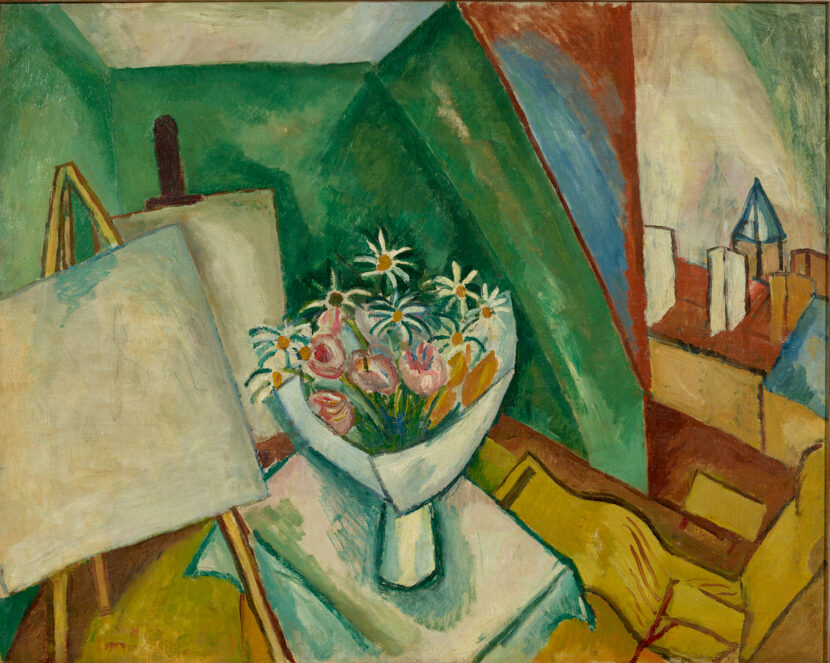
1909
Huile sur toile
Nice, musée des Beaux-Arts Jules Chéret, N.Mba 5603
Legs de Mme Émilienne Dufy en 1962
© François Fernandez – Ville de Nice
The room, with its oblique lines, seems to shrink as the outside masterfully penetrates. The easels, table and walls tilt, driven by a disquieting thrust. The painter seems to be dreaming of freedom, even though he is cloistered in his studio under the Parisian rooftops. The flowers, in the centre of the painting, retain their natural character: the starry shapes of the daisies, the round pink or orange anemones. Here, the artist puts the act of painting in abyme, the bouquet and the landscape being intended to be represented on the two blank canvases. Abandoning the pure colours used by the Fauves, Raoul Dufy’s palette became ‘southern’, with red and yellow ochres and shades of green.
Public garden in Hyères
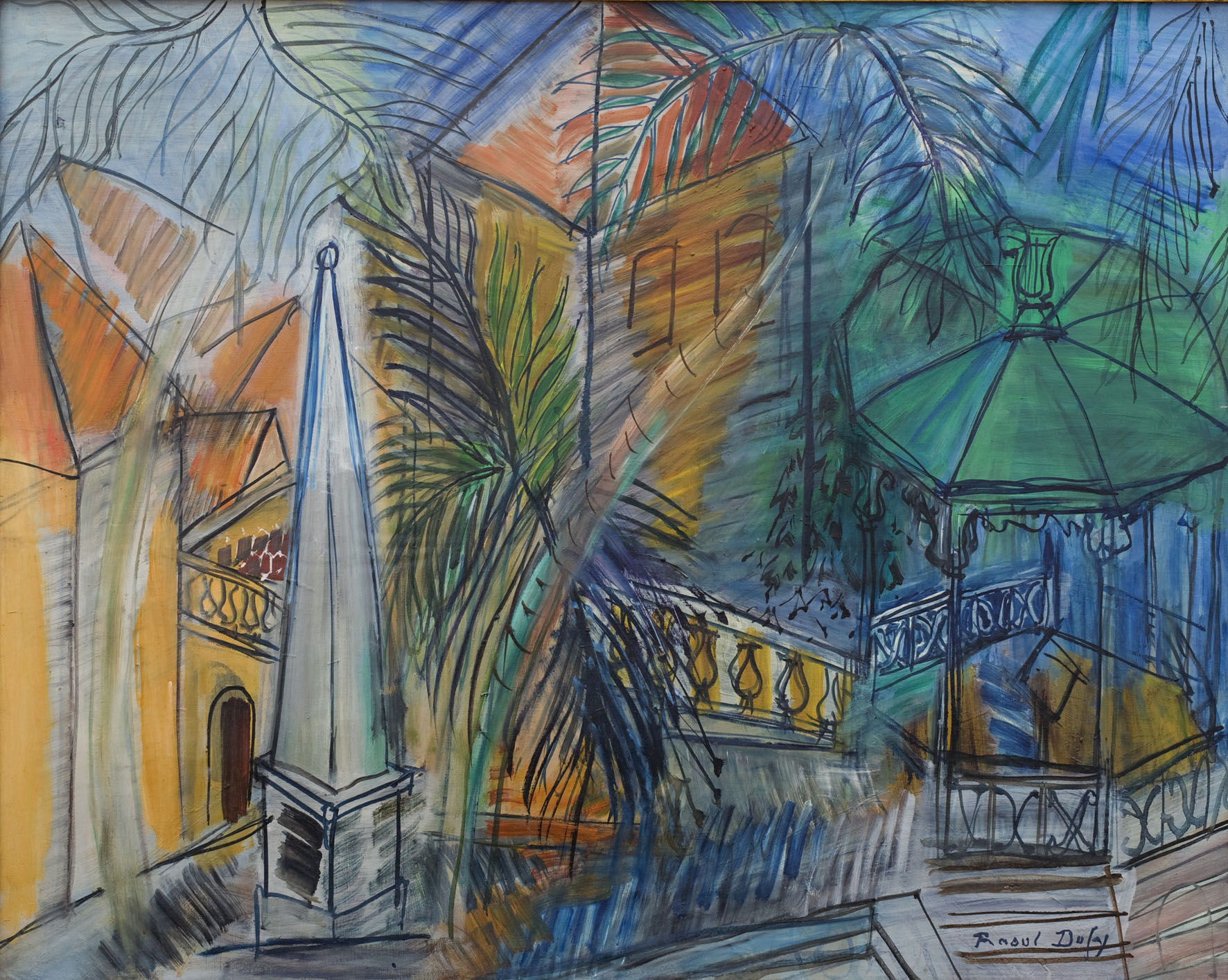
1952
Huile sur toile
Nice, musée des Beaux-Arts Jules Chéret, N.Mba 5624
Legs de Mme Émilienne Dufy en 1962
© Muriel Anssens – Ville de Nice
Prepared by numerous sketches, this painting shows Dufy’s preoccupation with the place of each element and the space between them. The artist wrote: ‘We have the tree, the bench, the house, but what interests me, the most difficult thing, is what’s around these objects. How to hold it all together. Nobody has done it like Cézanne; between his apples it’s as beautiful and important as the apples themselves. Here, Dufy depicts the obelisk, the kiosk, the balustrades and the buildings at different scales. He combines these motifs in a compact composition, so that a ‘conversation’ is established between them.
Danse and love
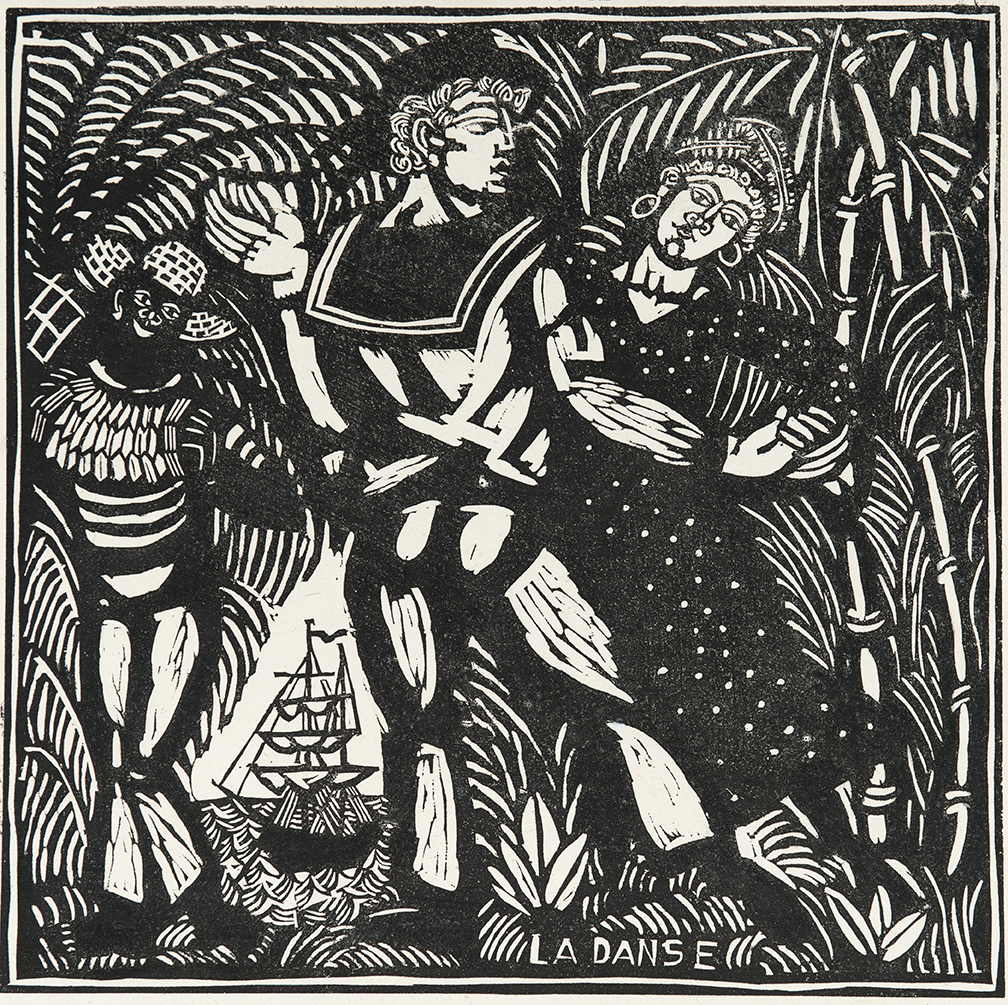
1910
Xylographie sur papier
Dépôt du Centre Pompidou Paris en 1977, Musée national d’art moderne/Centre de création industrielle, AM 10892 GR (275)
Nice, musée des Beaux-Arts Jules Chéret
© Muriel Anssens – Ville de Nice

1910
Xylographie sur papier
Dépôt du Centre Pompidou Paris en 1977, Musée national d’art moderne/Centre de création industrielle, AM 10892 GR (110)
Nice, musée des Beaux-Arts Jules Chéret
© Muriel Anssens – Ville de Nice
At the end of the 1900s, Dufy discovered Gauguin’s wood sculptures and engravings. Their astonishing stylisation struck the young artist and drew him towards both the decorative arts and a simplification known as ‘primitivism’. At the same time, an Encyclopaedia of Oriental Decorative Arts was published, which became a reference work for him. These extra-European iconographies influenced him, and are reflected in his illustrations for Bestiaire, particularly in the rendering of exotic vegetation.
Fishing
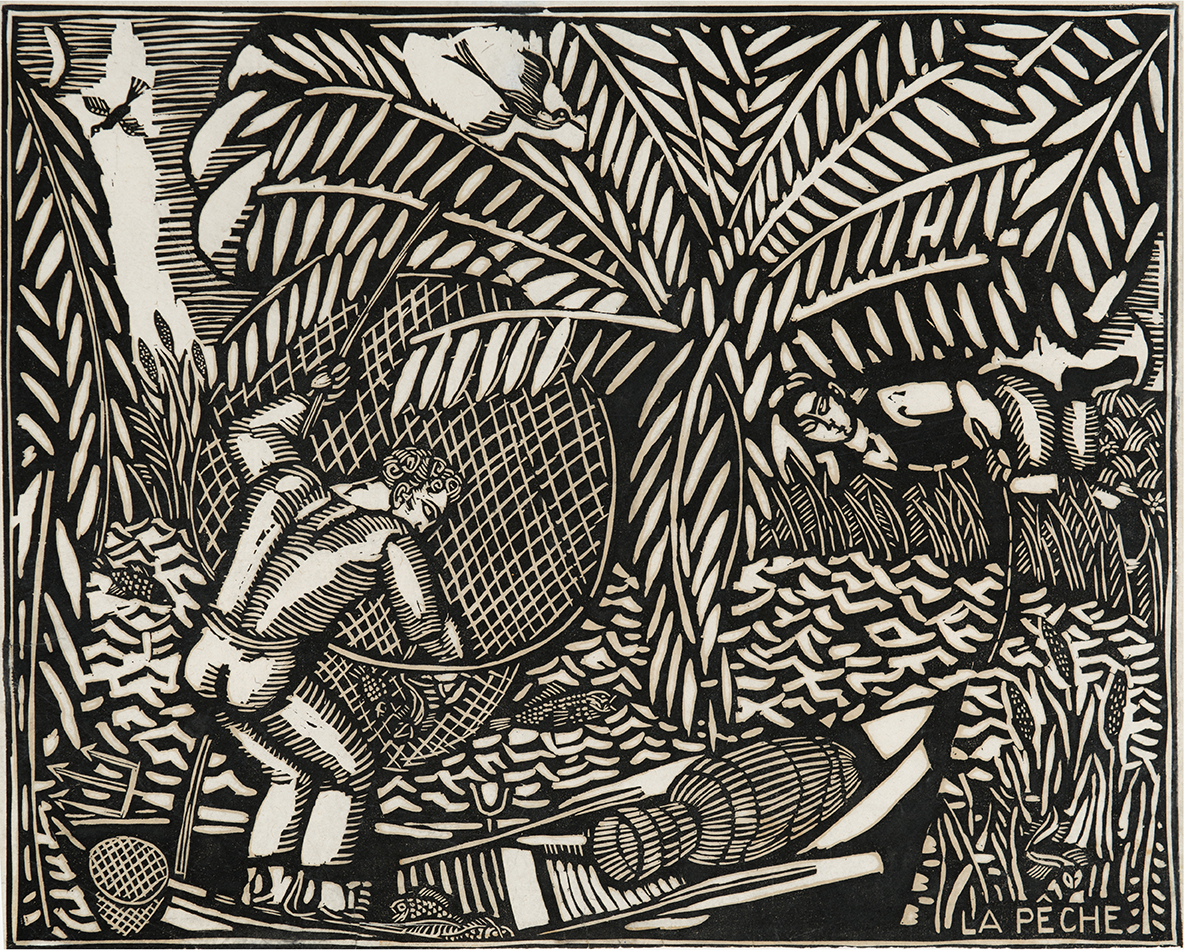
1910
Xylographie sur papier
Dépôt du Centre Pompidou Paris en 1977, Musée national d’art moderne/Centre de création industrielle, AM 10892 GR (277)
Nice, musée des Beaux-Arts Jules Chéret
© Muriel Anssens – Ville de Nice
Le Bestiaire ou Cortège d’Orphée is a collection of short poems in the tradition of the bestiaries of the Middle Ages, and is considered one of the masterpieces of twentieth-century illustration. Dufy worked on these thirty engravings for a year, manipulating scale, proportions and perspective, masterfully exploiting space and playing with contrasts of black and white.
He also created four independent plates that open the collection: Dance, Love, Fishing and Hunting.
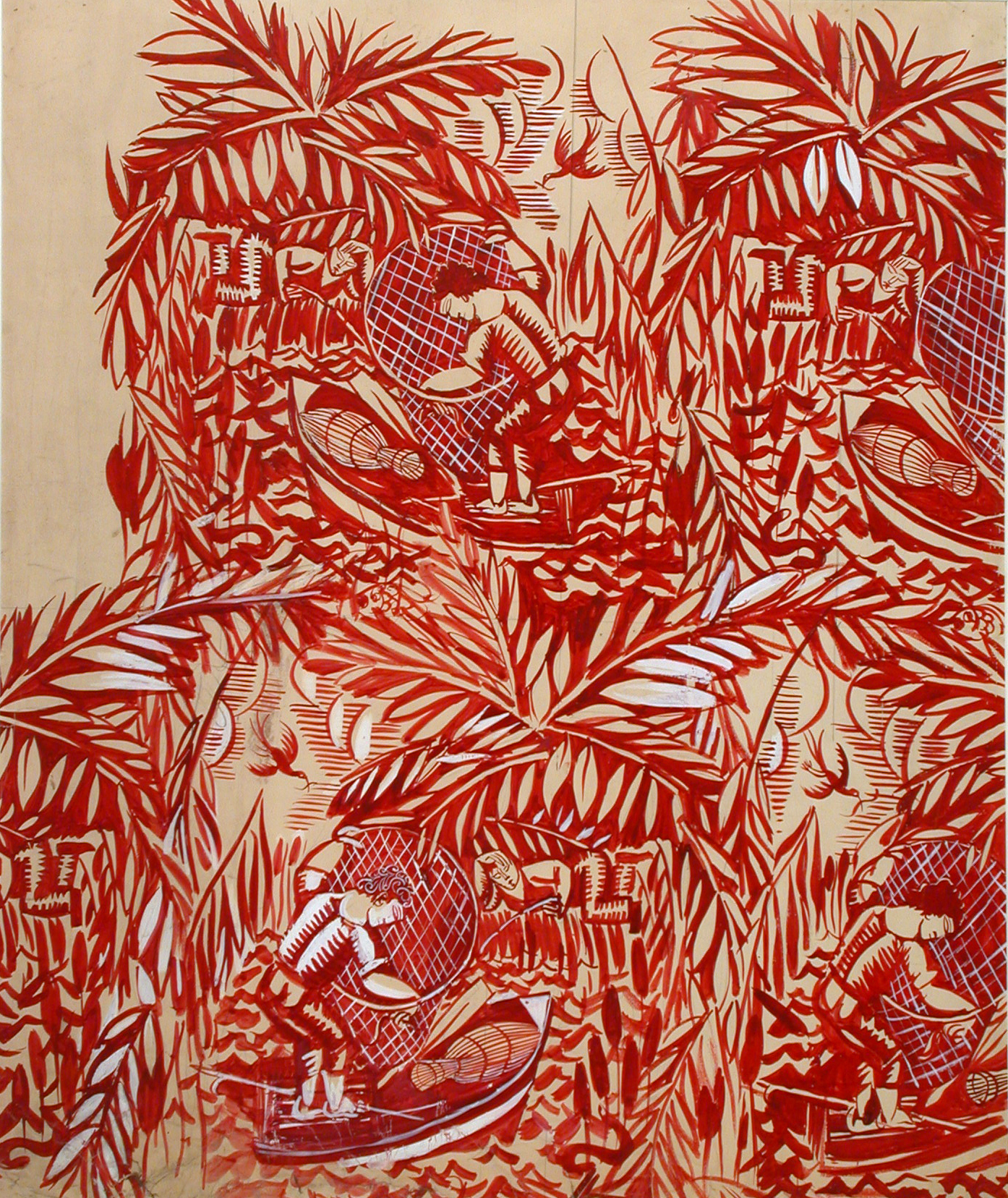
Fishing
Vers 1919
Gouache sur papier
Nice, musée des Beaux-Arts Jules Chéret, N.Mba 6128
Achat de la Ville de Nice en 1986
© Muriel Anssens – Ville de Nice
At Paul Poiret’s request, Dufy reproduced the La Pêche motif on a hanging made at La Petite Usine, their makeshift factory. The wood used for La Danse, La Pêche and La Chasse was also used to print fabrics in the Bianchini-Férier workshops in Tournon-sur-Rhône (Ardèche). For almost fifteen years, the painter created compositions of flowers and foliage, sometimes with animal motifs, mythological characters, couples of dancers and musicians, and other scenes from everyday life.
The murdered poet
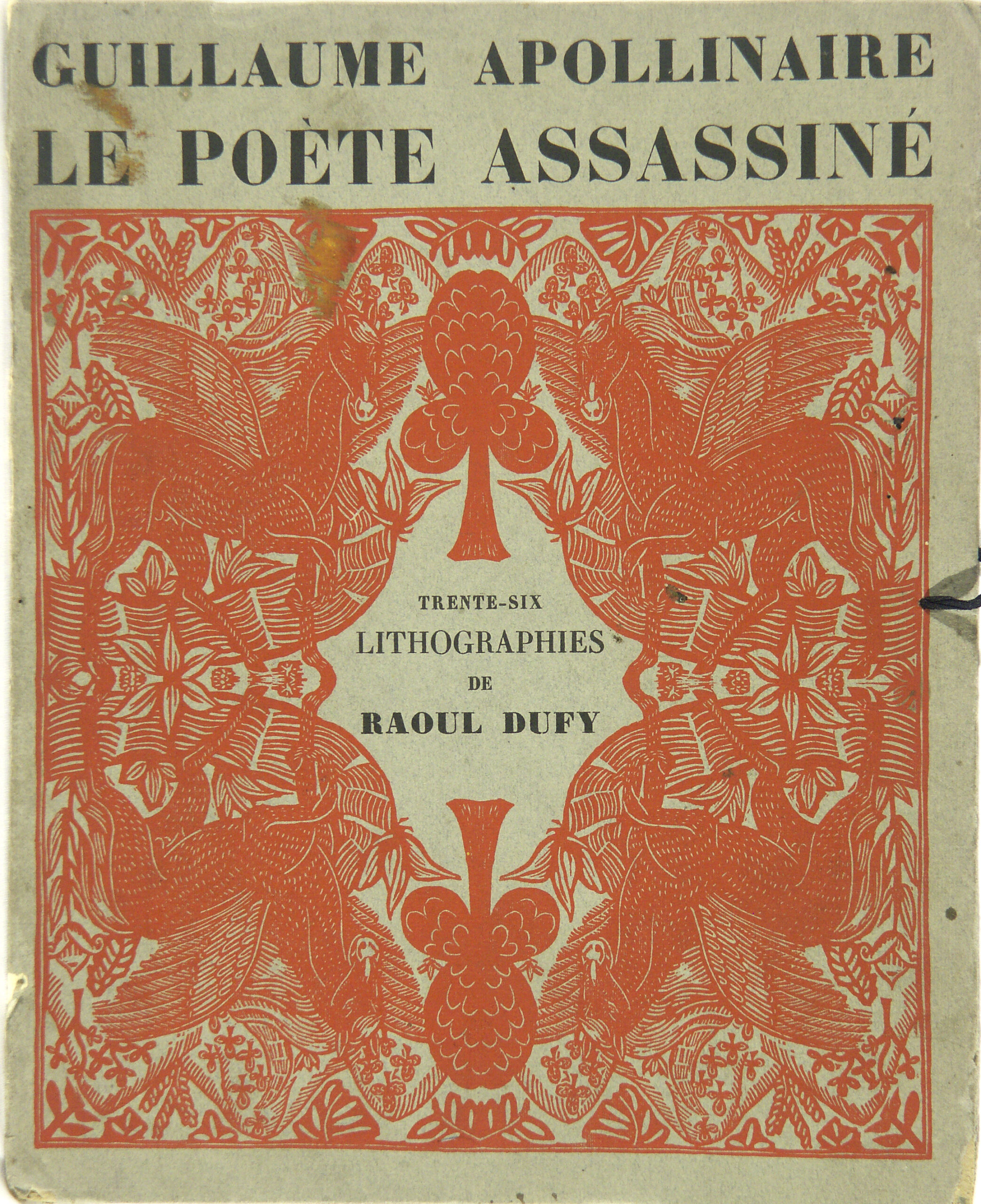
Le Poète Assassiné
1926
Xylographie sur papier
Dépôt du Centre Pompidou Paris en 1977, Musée national d’art moderne/Centre de création industrielle, AM 10892 GR (501)
Nice, musée des Beaux-Arts Jules Chéret
© Muriel Anssens – Ville de Nice
The cover of the book, in grey cardboard, features the engraving of the Horse from the Bestiaire, printed four times in a single block and mirrored, inverted and reversed, in red ink. Pegasus, symbolising the poet’s mastery of lyrical inspiration, presides over the development of the new project.
Giving birth
1926
Lithographie sur papier
Dépôt du Centre Pompidou Paris en 1977, Musée national d’art moderne/Centre de création industrielle, AM 10892 GR (300 V)
Nice, musée des Beaux-Arts Jules Chéret
© Muriel Anssens – Ville de Nice
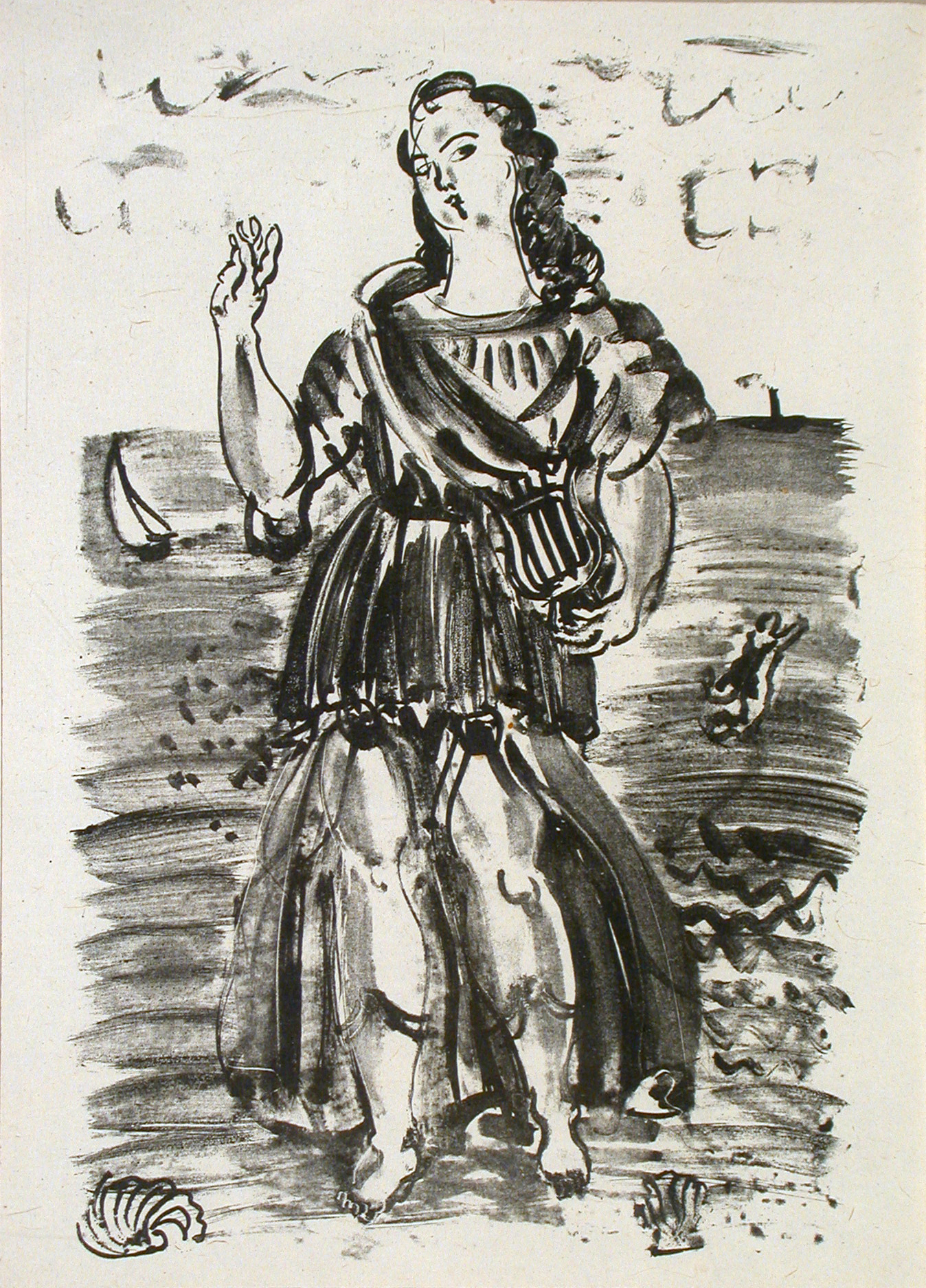
Le Poète Assassiné is a fictional autobiography by Guillaume Apollinaire, under the pseudonym Croniamantal. It focuses on his relationship with two characters, L’oiseau du Bénin and Tristouse Ballerinette, who are the respective avatars of the painters Pablo Picasso and Marie Laurencin. Raoul Dufy associates Apollinaire with Orpheus, depicted in this print. Orpheus was a mythological hero, poet and musician, supposedly capable of charming all creation with his compositions.
Renown
1926
Xylographie sur papier
Dépôt du Centre Pompidou Paris en 1977, Musée national d’art moderne/Centre de création industrielle, AM 10892 GR (288)
Nice, musée des Beaux-Arts Jules Chéret
© Muriel Anssens – Ville de Nice
Raoul Dufy chose to introduce each of the eighteen chapters with two lithographs, one hors-texte, the other occupying a third of a page above the text.
This choice allows the reader to savour the semantic and sonorous interplay of Apollinaire’s prose, while at the same time giving the painter iconographic autonomy.
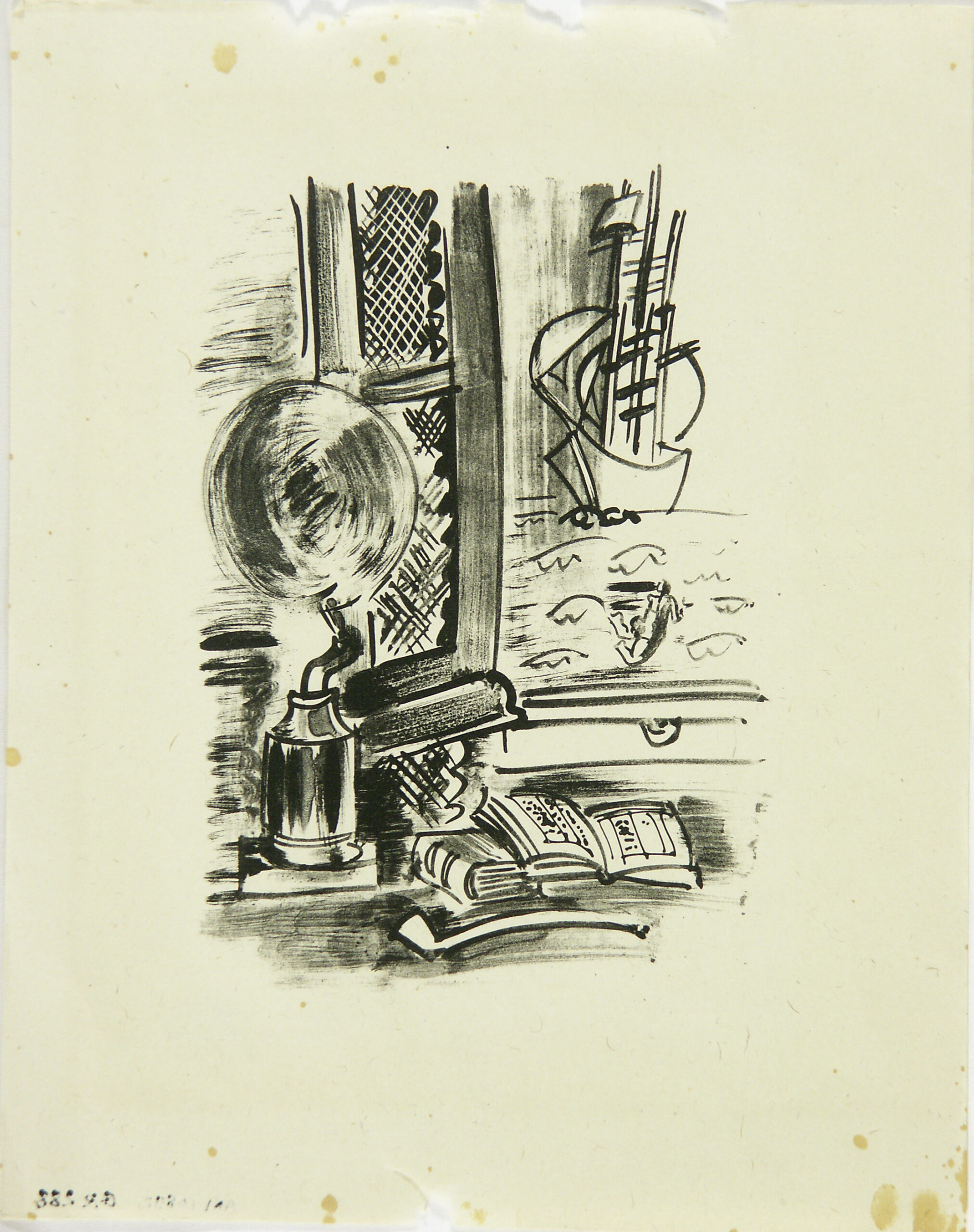
The first lithograph in the book offers visual puns on the theme of escape, with the book in the foreground and the window open onto the sea. A large sailboat offers the promise of a beautiful voyage, confirmed by the wind swelling the sails and whipping up the waves, while a fan relays the breeze inside the room.
Renown
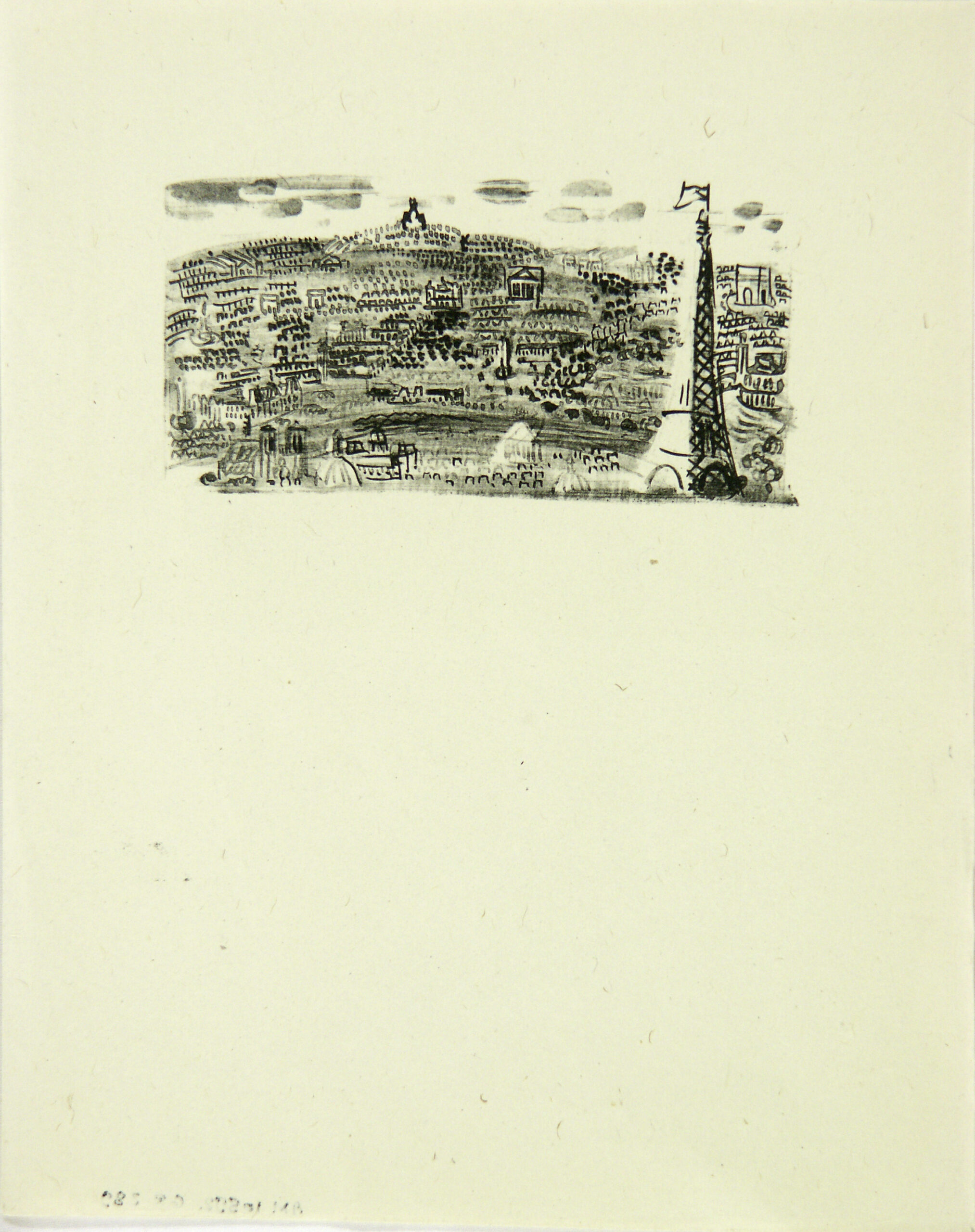
1926
Xylographie sur papier
Dépôt du Centre Pompidou Paris en 1977, Musée national d’art moderne/Centre de création industrielle, AM 10892 GR (289)
Nice, musée des Beaux-Arts Jules Chéret
© Muriel Anssens – Ville de Nice
Raoul Dufy’s lithographs illustrate neither the events nor the characters, but focus on the story’s constant travels across Europe. They include Paris, Liège, the Côte d’Azur, Rome, Munich, a Rhine landscape and the port of Marseille.
Mammon
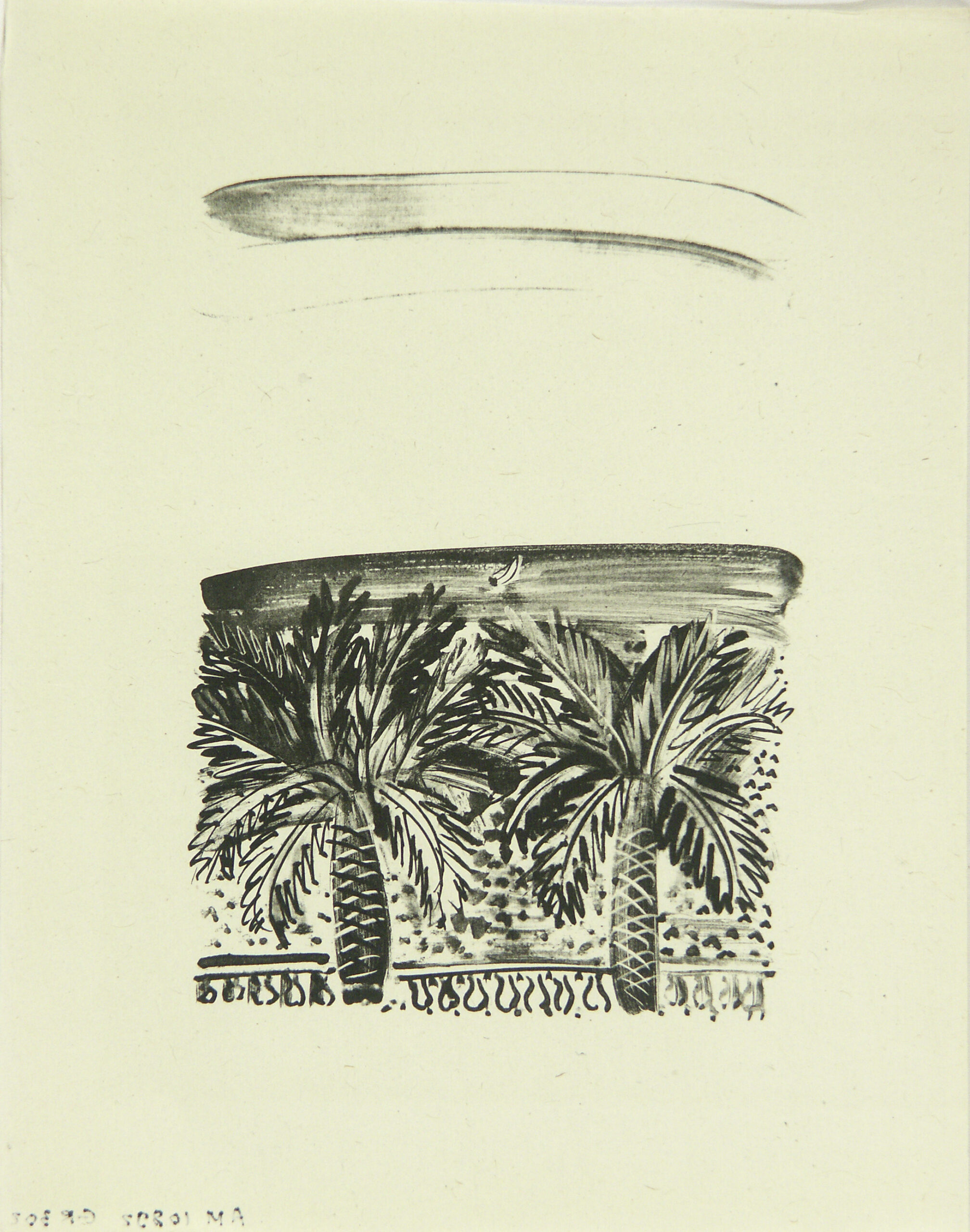
1926
Xylographie sur papier
Dépôt du Centre Pompidou Paris en 1977, Musée national d’art moderne/Centre de création industrielle, AM 10892 GR (302)
Nice, musée des Beaux-Arts Jules Chéret
© Muriel Anssens – Ville de Nice
With lithography, Dufy rediscovered the art of gradation by modulating the flow of ink onto the lithographic stone. He thus succeeded in obtaining subtle effects of relief, depth and chiaroscuro. Some compositions were sprinkled with tiny drops of ink, evoking a rain of light. In others, a broad black line on the sky suggests a blinding light, like a dark disc veiling the eyes of someone staring at the sun.
Mammon
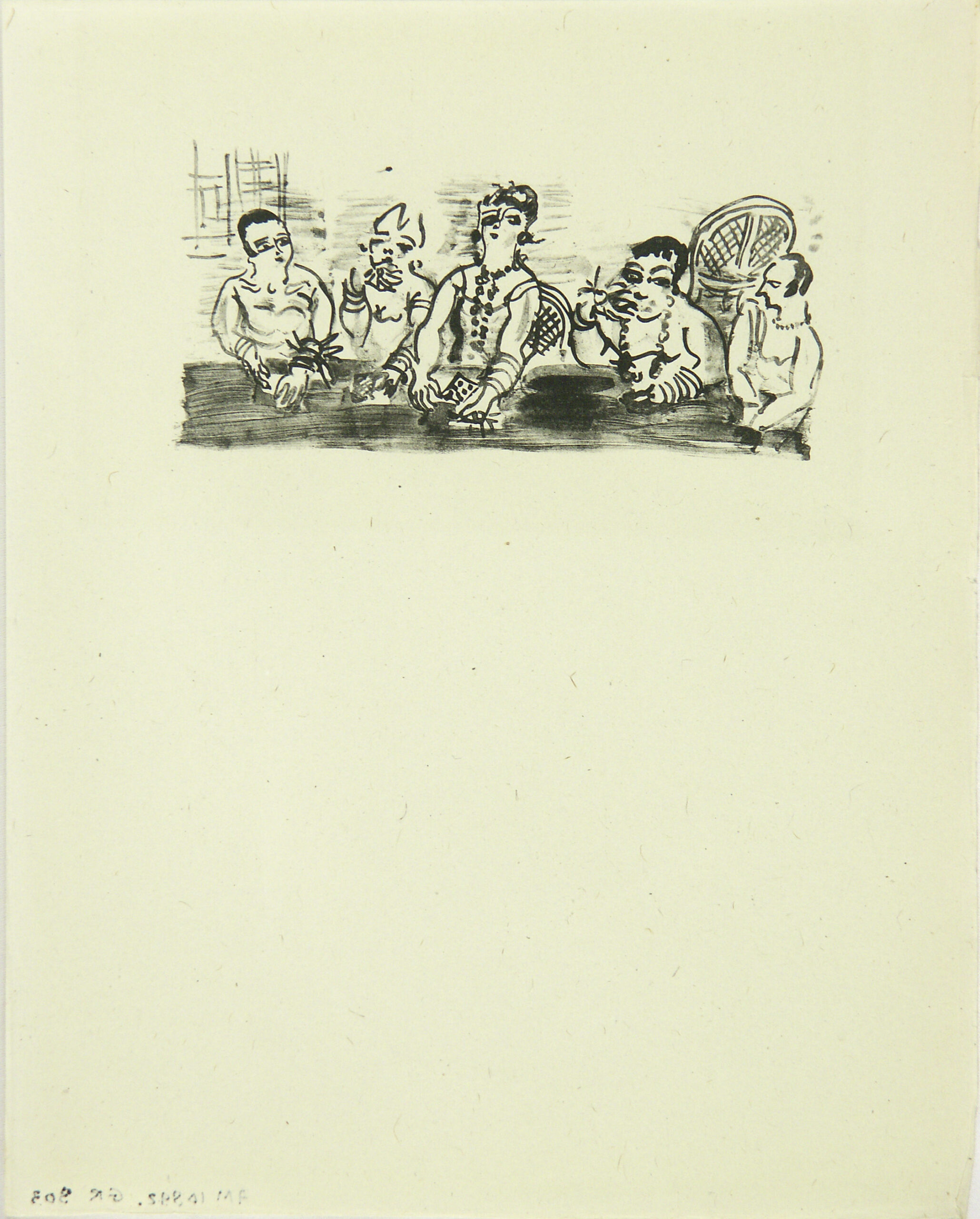
1926
Xylographie sur papier
Dépôt du Centre Pompidou Paris en 1977, Musée national d’art moderne/Centre de création industrielle, AM 10892 GR (303)
Nice, musée des Beaux-Arts Jules Chéret
© Muriel Anssens – Ville de Nice
The scene is seen from the point of view of the croupier, who is facing ladies adorned with diamonds and seated at a baccarat table. Here, Dufy’s spirit of caricature meets Apollinaire’s satirical pen.
Apotheosis
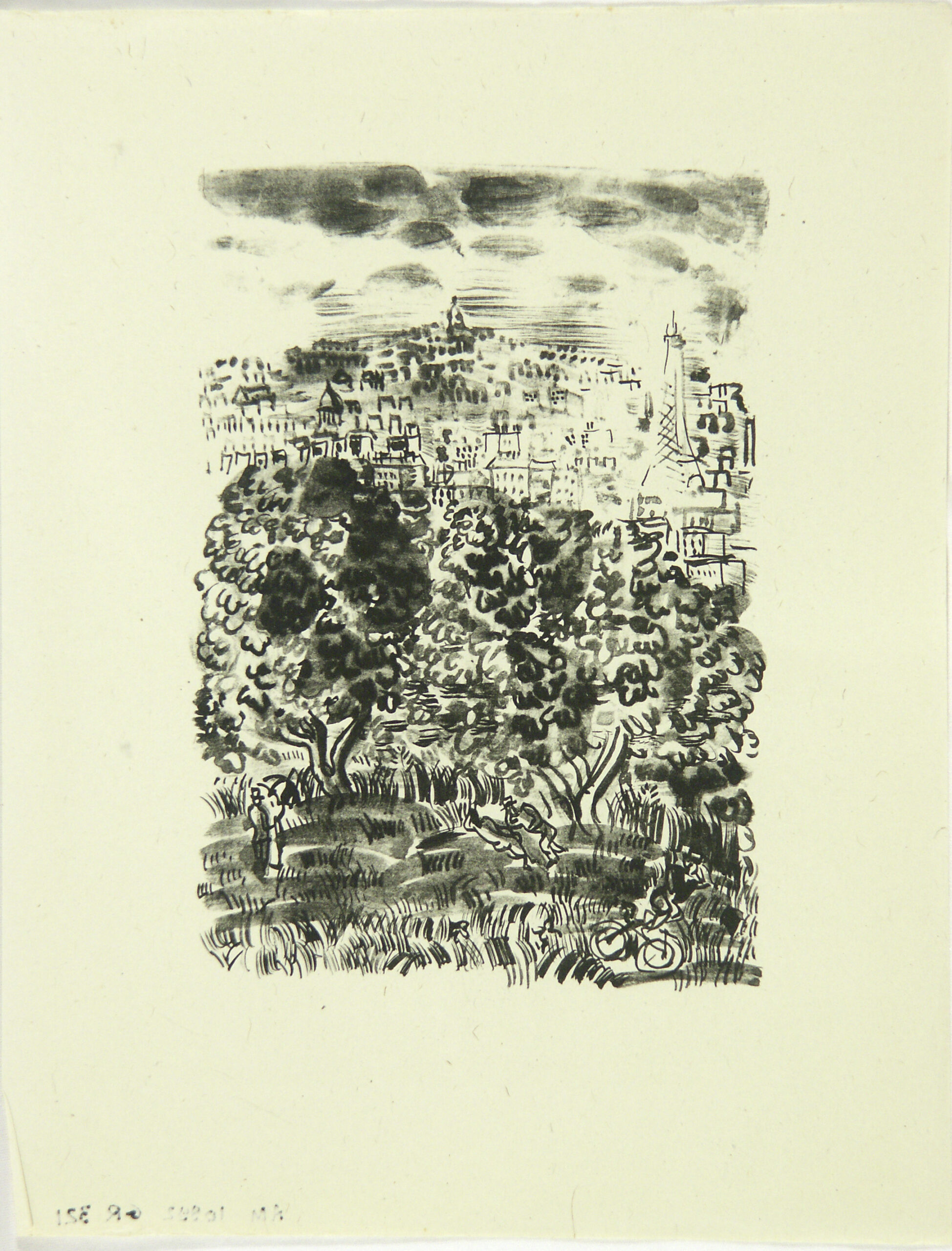
1926
Xylographie sur papier
Dépôt du Centre Pompidou Paris en 1977, Musée national d’art moderne/Centre de création industrielle, AM 10892 GR (321)
Nice, musée des Beaux-Arts Jules Chéret
© Muriel Anssens – Ville de Nice
In the last chapter, Dufy offers a bird’s-eye view of a peaceful clearing, behind which the city of Paris stretches to the horizon, bathed in light. In the foreground is the Bois de Meudon, the place where, at the end of the story, the Benin bird creates a monument in memory of his friend Croniamantal.
Statue with two red vases

Statue aux deux vases rouges
1942
Tapisserie en laine
Nice, musée des Beaux-Arts Jules Chéret, N.Mba 6132
Legs de Mme Émilienne Dufy en 1962
© Muriel Anssens – Ville de Nice
Although Raoul Dufy had been using his talent for textiles since 1911, it was not until 1925 that he received his first commission for tapestry cartoons. It came from Jean Ajalbert, the administrator of the Manufacture de Beauvais, who was trying to revive the declining workshops using modern painters. That same year, Dufy met Marie Cuttoli, another major player in the renewal of modern tapestry. To revive the Aubusson workshops, she approached him in 1934, as she had done with other avant-garde artists such as Jean Lurçat and Henri Matisse, to design cartoons for wall tapestries and furniture. Raoul Dufy subsequently began new collaborations, notably with Jean Lurçat. With the support of his dealer Louis Carré, he created tapestries from 1944 until the end of his life.
Vase with bathers on a yellow background
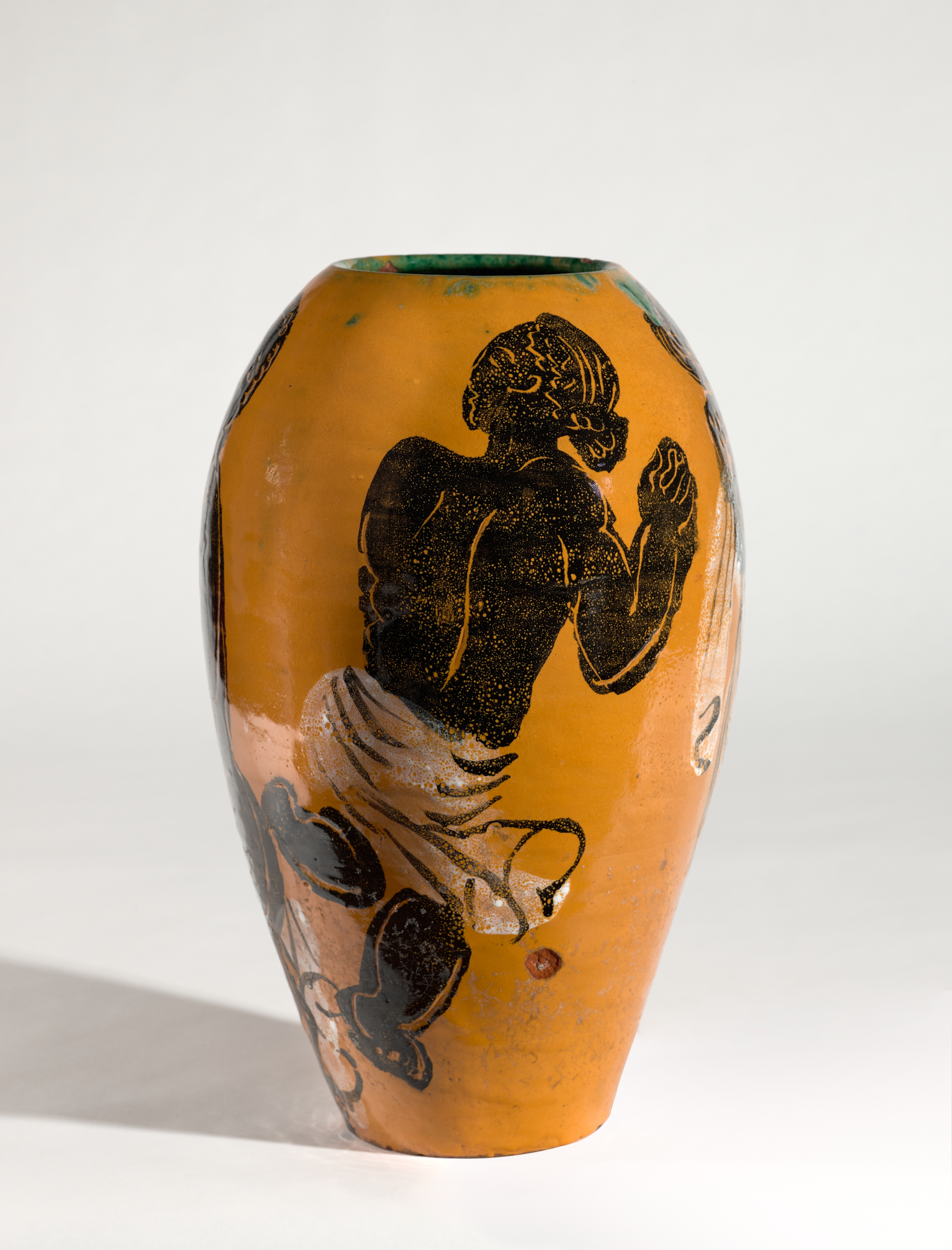
Vase aux baigneuses sur fond jaune
11 octobre 1926
Faïence stannifère peinte
Nice, musée des Beaux-Arts Jules Chéret, N.Mba 6133
Legs de Mme Émilienne Dufy en 1962
© François Fernandez – Ville de Nice
Raoul Dufy’s meeting with Josep Llorens i Artigas in 1922 paved the way for a fruitful collaboration.
Ceramics offered Dufy a new technique for exploring the potential of engraved and painted matter.
Artigas’s glazes, carefully prepared and numbered, allowed Dufy to choose from a wide palette. They worked together on the shape of the vases, but the decorations were created by the painter. He took great pleasure in blending feminine curves with the contours of the pieces he created, such as the bathers whose shapes hug the body of the vase shown here, creating a sensation of movement.
Tribute to Claude Debussy

1952
Huile sur toile
Nice, musée des Beaux-Arts Jules Chéret, N.Mba 5623
Legs de Mme Émilienne Dufy en 1962
© Muriel Anssens – Ville de Nice
This canvas is part of a series of paintings paying tribute to the painter’s favourite musicians: Bach, Mozart, Chopin and Debussy. Music played a major role in Dufy’s work: the artist sought to transcribe rhythm and melody in his paintings. This is one of the reasons why he dissociates the outline of the motifs from the colour. The patches of colour symbolise a musical background that runs through all the objects in the room, and each hue evokes a tonality.
The artist’s studio in Vence

1945
Aquarelle et gouache sur papier
Nice, musée des Beaux-Arts Jules Chéret, N.Mba 2857
Don de Mme Émilienne Dufy en 1955
© Muriel Anssens – Ville de Nice
Dufy spent May 1945 in Vence with his wife Émilienne, where he painted views of her studio and had her pose nude. The gouache shown here is one of the preparatory sketches for the canvas reproduced in the Musée Joseph Déchelette in Roanne (on deposit with the Centre Pompidou, MNAM-CCI). Unconvinced by the model’s position, Dufy erased it from the gouache and placed it in the opposite direction on his canvas. The Grande Baigneuse reproduced on the left wall of the sketch was finally abandoned in favour of a closed drawing board placed against a table.
In these two works, the artist plays on the porosity between interior and exterior space, through the window. The hills of Vence, bathed in the azure Mediterranean sky, appear here like a painting within a painting.
Interior at Vernet les Bains
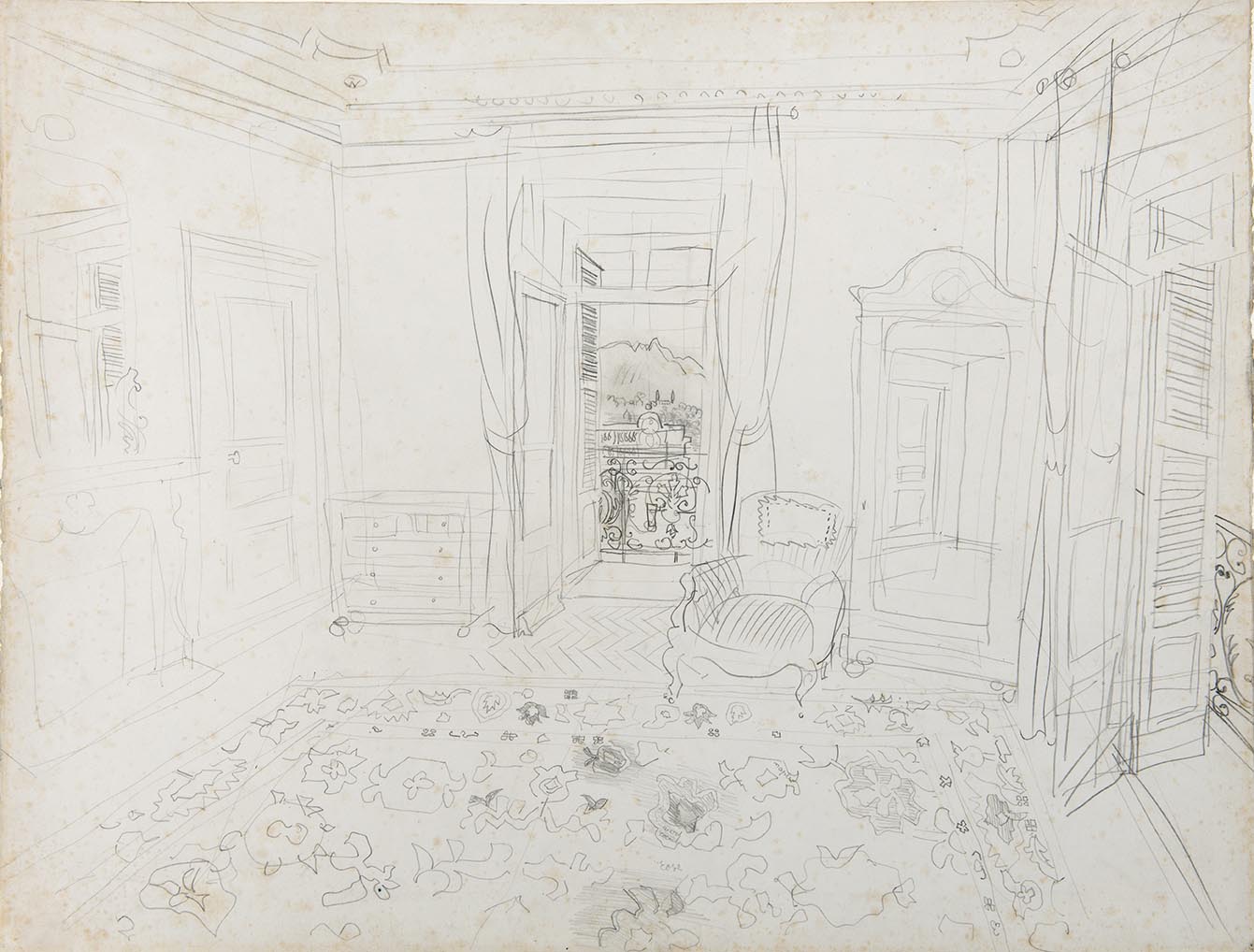
1942
Crayon sur papier
Nice, musée des Beaux-Arts Jules Chéret, N.Mba 6245
Legs de Mme Émilienne Dufy en 1962
© Muriel Anssens – Ville de Nice
In Céret, Raoul Dufy came into contact with Dr Pierre Nicolau, who specialised in the treatment of polyarthritis. The two men became such good friends that the doctor took the painter in for six months and invited him on several occasions to his country house at Vernet-les-Bains, one room of which is shown here. The carpet, a veritable flowerbed, is a reminder of Dufy’s growing interest in painting flowers, and echoes the many watercolours on this motif that he produced during these stays.
Nude on the patio
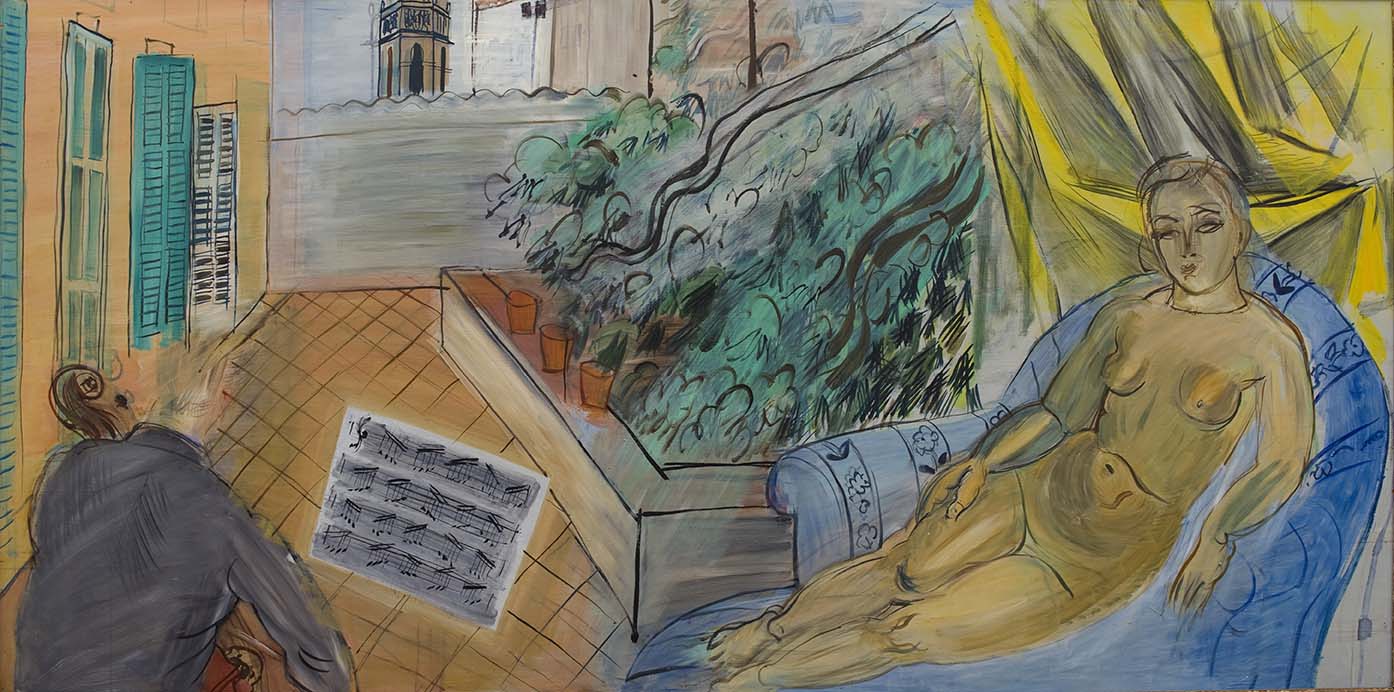
1945
Huile sur toile
Nice, musée des Beaux-Arts Jules Chéret, N.Mba 5615
Legs de Mme Émilienne Dufy en 1962
© Muriel Anssens – Ville de Nice
In the 1940s, Raoul Dufy and his companion Berthe Reisz went to Caldes de Montbui, a town renowned for its thermal waters. It was in the patio of the Hôtel Balneario Rius, where they were staying, that Dufy set the scene for this work: the bell tower of the church of Santa Maria de Caldes de Montbui can be seen in the background. The meridian on which Berthe is sitting comes from the Perpignan studio. The headless musician playing a floating score could be Pablo Casals, a famous cellist whom Dufy met at Dr Nicolau’s house and befriended. The work thus appears to be a synthesis of the places, models and themes the painter dealt with in the 1940s. It is also a reinterpretation of Titian’s Venus and the Organ Player, which Dufy had discovered at the Prado Museum.
Flat garden
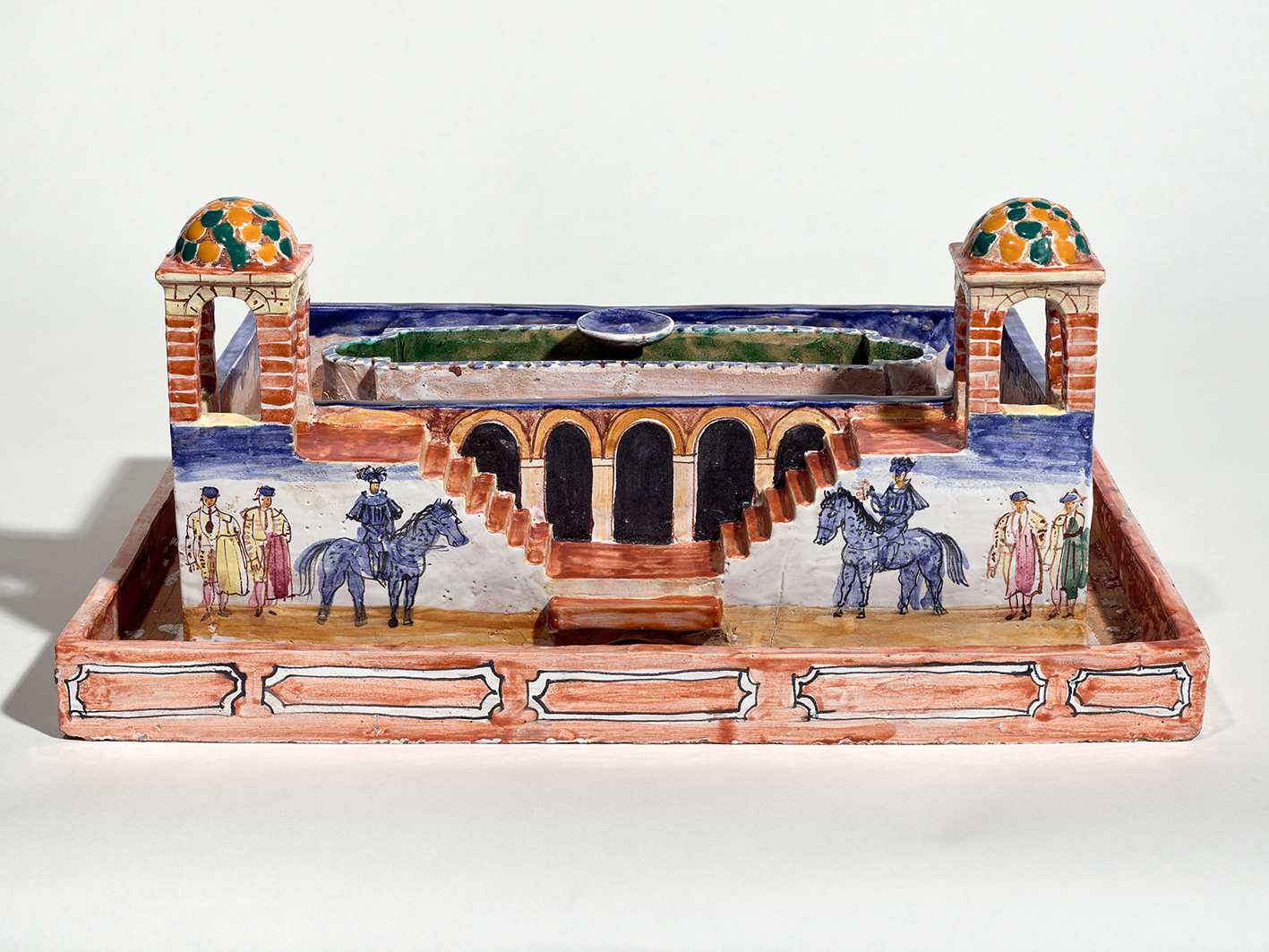
Jardin d’appartement : tauromachie
Vers 1927
Céramique
Nice, musée des Beaux-Arts Jules Chéret, N.Mba 6135
Legs de Mme Émilienne Dufy en 1962
© François Fernandez – Ville de Nice
In the spring of 1926, Raoul Dufy and Josep Llorens i Artigas worked with the Catalan architect Nicolau Maria Rubió to design a series of ‘salon gardens’. Rubió designed the models for a first series. Shaped by the potter Artigas and decorated by Dufy with motifs familiar from his repertoire, these earthenware gardens are embellished with architectural references borrowed from Western tradition, but are landscaped with plant compositions of dwarf trees in the Japanese style. In all, some forty gardens were created between 1927 and 1930 and exhibited in Paris, Brussels, London and New York. Until 1938, Dufy continued the vase and tile decoration he had begun in 1923 with Artigas.
Yellow console with two windows
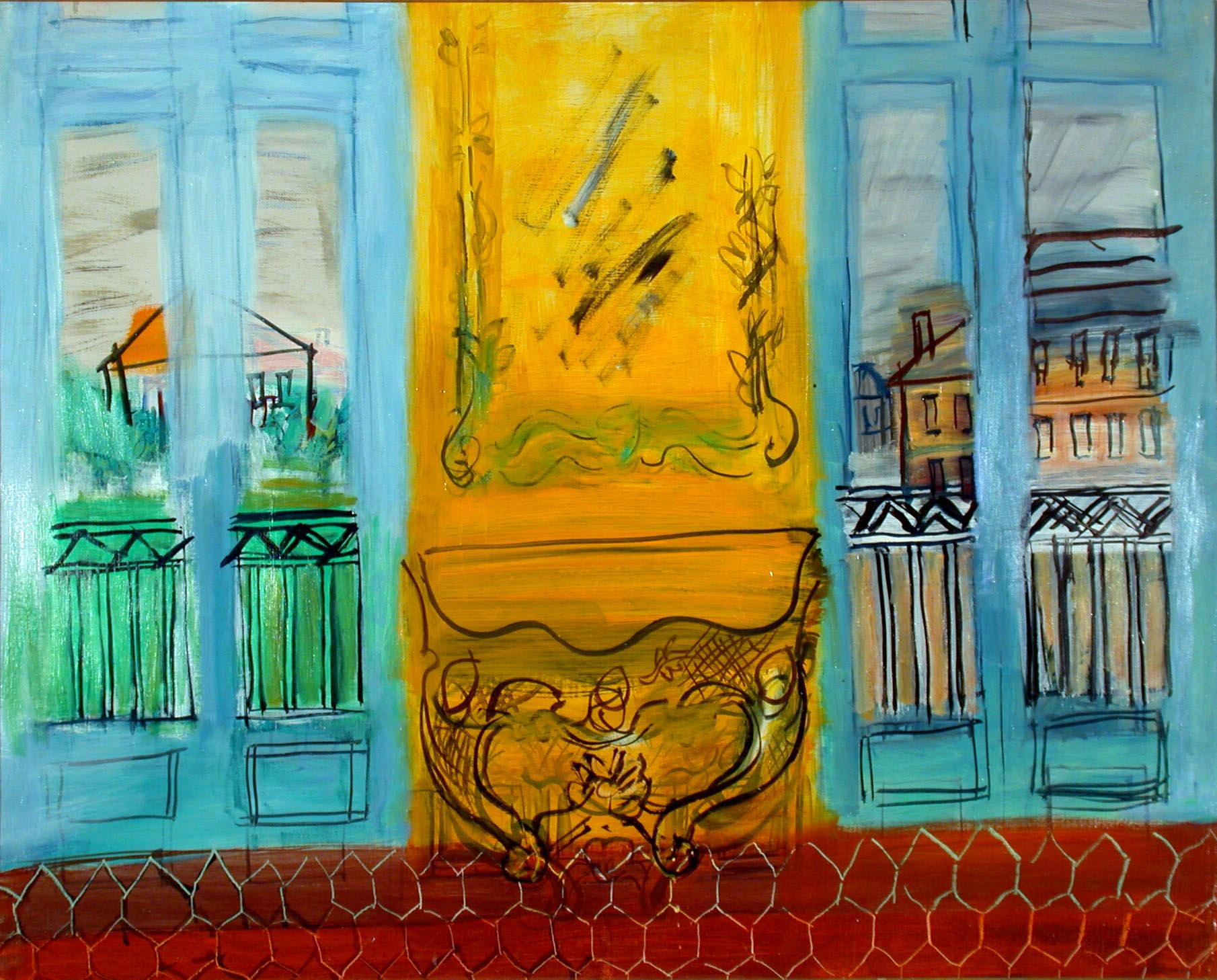
1948
Huile sur toile
Nice, musée des Beaux-Arts Jules Chéret, N.Mba 5617
Legs de Mme Émilienne Dufy en 1962
© Muriel Anssens – Ville de Nice
In 1946, Raoul Dufy moved into an apartment-studio at 2, rue de l’Ange in Perpignan. It is recognisable by the Louis XV console table, which has become the emblematic motif in so many of his works from this period. It is framed by two high windows that offer a bird’s-eye view of the Place Arago. The artist could easily observe the many popular festivities and open-air concerts taking place there. Above the console, a barely sketched mirror forms another window onto the enclosed space of the room.
Nude with shell
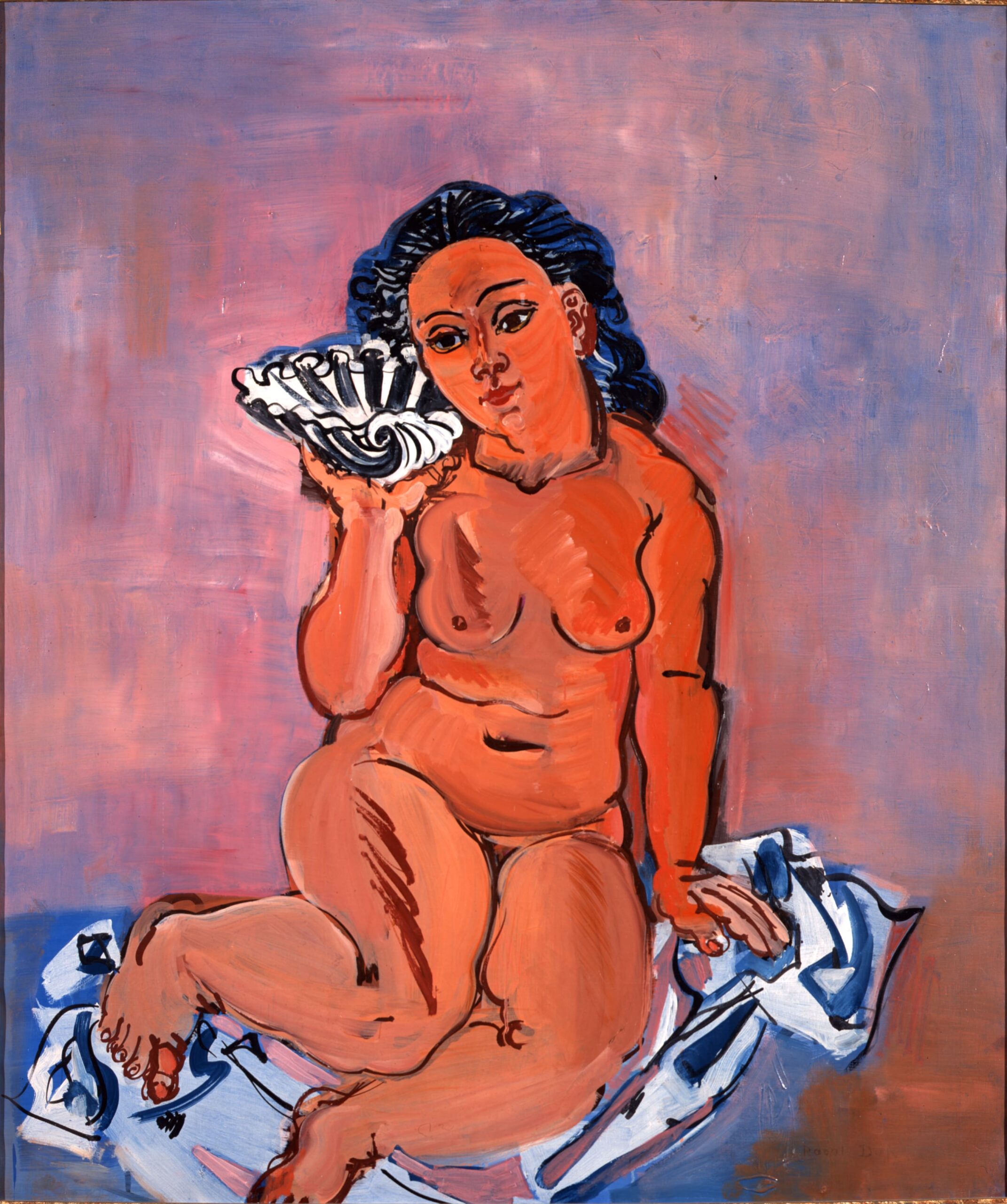
1933
Huile sur toile
Nice, musée des Beaux-Arts Jules Chéret, N.Mba 5609
Legs de Mme Émilienne Dufy en 1962
© Muriel Anssens – Ville de Nice
In this monumental painting, Raoul Dufy refers to Greek mythology. He evokes the marine divinity Amphitrite, the feminine personification of the sea. This figure appeared in his work after his discovery of the ancient sites of Sicily in 1925. The shell is one of Aphrodite’s main attributes. By incorporating it into his composition, Dufy associated the two goddesses, making this work a masterly ode to femininity. The background of shades of pink, blue and ochre, evoking the iridescence of mother-of-pearl, highlights the body of the goddess.
Tribute to Claude Lorrain

1927
Huile sur toile
Nice, musée des Beaux-Arts Jules Chéret, N.Mba 5606
Legs de Mme Émilienne Dufy en 1962
© Muriel Anssens – Ville de Nice
From 1917 to 1929, Raoul Dufy produced a series of watercolours and paintings in homage to the painter Claude Gelée, known as le Lorrain (1600-1682). These works bear witness to a personal interpretation of the master’s aesthetic. Dufy offers us his conception of a recomposed landscape, an imaginary and idealised evocation of a site. From Le Lorrain’s art, he retained a composition structured according to the proportions of the golden ratio, with an opening towards the open sea and the representation of classical architecture. In the foreground of the painting opposite, the baroque tritone fountain of the town of Hyères is enthroned, while the Colosseum in Rome can be seen in the background on the left. Other motifs dear to the painter’s heart also feature in this series: sailing boats, steamships and horse-drawn carriages.
This canvas has the particularity of being flooded with a dominant black colour: it expresses the intensity of a light so incandescent that it seems to have burnt the canvas itself.
Imaginary Venice
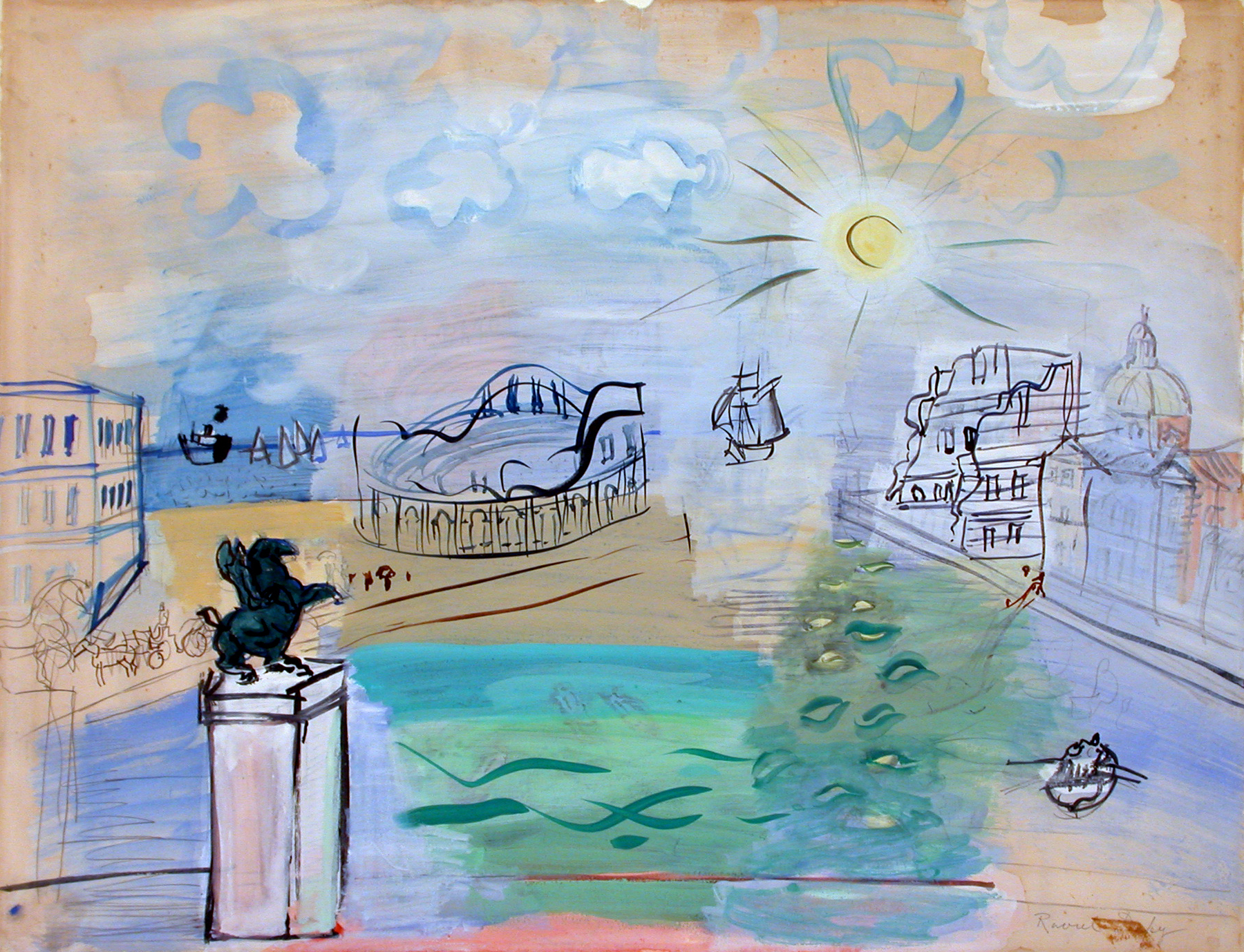
Vers 1950
Aquarelle et gouache sur papier
Nice, musée des Beaux-Arts Jules Chéret, N.Mba 2860
Don de Mme Émilienne Dufy en 1955
© Muriel Anssens – Ville de Nice
This work is part of a series devoted to Claude Gelée, known as le Lorrain (1600-1682). Here we find the classical architecture so dear to the master, bordering on the open sea. A horse-drawn carriage, a sailing boat, a steamboat and an arena are juxtaposed in this imaginary evocation of Venice, a tribute to the mythical city.
It’s rare enough to be mentioned: a yellow sun blossoms in the sky. Raoul Dufy preferred black, however, which he felt was best suited to conveying the dazzling power of the sun. As a result, only a few watercolours feature a yellow sun, albeit surrounded by black.
Entrance to the port of Trouville

Vers 1934
Huile sur toile
Nice, musée des Beaux-Arts Jules Chéret, N.Mba 5610
Legs de Mme Émilienne Dufy en 1962
© Muriel Anssens – Ville de Nice
With a technique all his own, Dufy refers here to the genesis of Impressionism, as he knew it in his youth by looking at the works of Eugène Boudin and Claude Monet. The broad blue strokes come together, fusing the sky and the sea.
The Great Bather
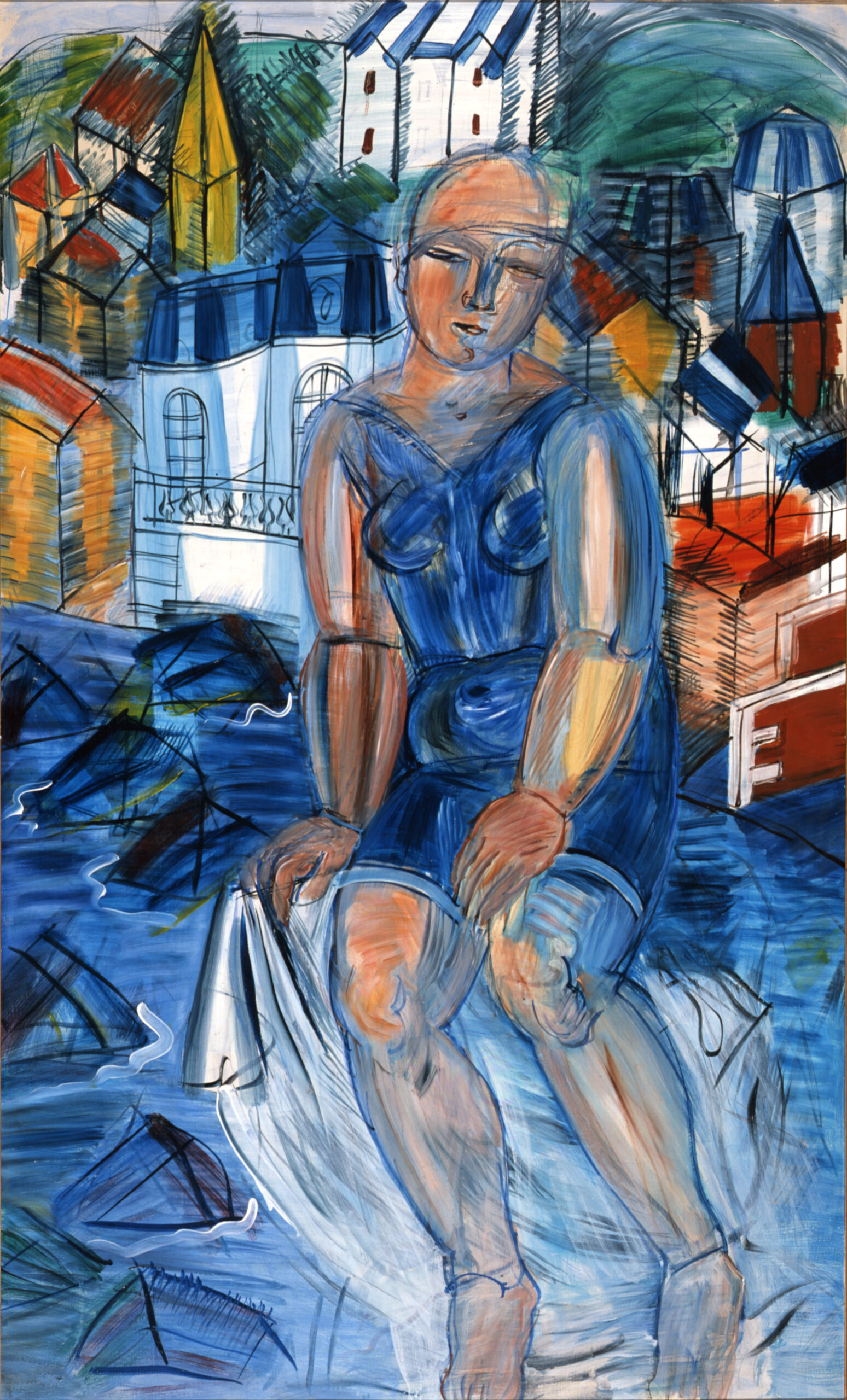
1950
Huile sur toile
Nice, musée des Beaux-Arts Jules Chéret, N.Mba 5620
Legs de Mme Émilienne Dufy en 1962
© Muriel Anssens – Ville de Nice
La Grande Baigneuse belongs to a series of works that Raoul Dufy produced at different periods in his career.
The first was completed in 1914, while the version shown here, one of the last, dates from 1950.
They are all set in the bay of Sainte-Adresse (Normandy), with the town’s buildings, and in particular its bell tower, visible in the background. The monumental bather, all curves and curvatures, dominates the composition. She is seated on a rock covered with a white sheet and surrounded by waves represented by triangular prisms.
This late revival of the theme appears to us as the spontaneous introspection of a man in the evening of his life, stricken by illness, who is returning to his roots, favouring this landmark of his youth. The loose brushstrokes, giving the impression of incompleteness, underline a freer pictorial style: it undoubtedly paves the way for contemporary figurative language.
Races in Henley

Entre 1935 et 1952
Huile sur toile
Nice, musée des Beaux-Arts Jules Chéret, N.Mba 5626
Legs de Mme Émilienne Dufy en 1962
© Muriel Anssens – Ville de Nice
This work belongs to a series whose first composition dates from 1931. The construction is daring: the gigantic pavilions in the foreground, with their disproportionate ratio of scale, create depth even though the general perspective is rectified. Dufy mastered the art of harmoniously combining a multitude of planes and motifs. The aerial viewpoint encompasses all the elements in a whole teeming with life.
Casino de la Jetée-Promenade

1927
Huile sur toile
Nice, musée des Beaux-Arts Jules Chéret, N.Mba 5617
Legs de Mme Émilienne Dufy en 1962
© Muriel Anssens – Ville de Nice
In most of Raoul Dufy’s views of Nice, palm trees imprint the decorative pattern of their outstretched branches on the sky. The painter happily reused this motif in the sketches for textiles he supplied to Bianchini-Ferrier.
From Nice, he also liked to depict the curve of the Promenade des Anglais, which he animated with walkers, horse-drawn carriages and cars. The Casino de la Jetée-Promenade, with its orientalist eclecticism, fascinated Dufy, who depicted it from every angle, close up or far away, day or night, in the background or as the central subject of his composition. Although it was demolished in 1944, he continued to use it in his paintings, as can be seen in the version painted in 1950, opposite.
The Mai at Nice
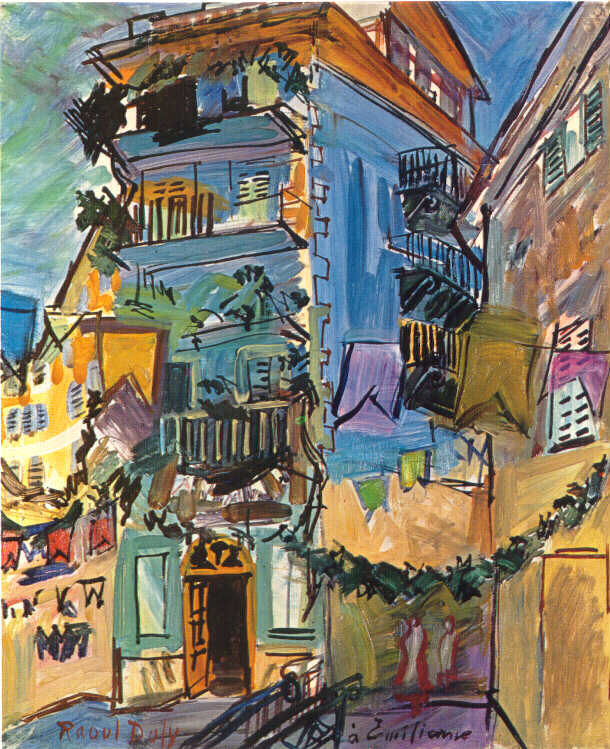
Entre 1930 et 1933
Huile sur toile
Nice, musée des Beaux-Arts Jules Chéret, N.Mba 5608
Legs de Mme Émilienne Dufy en 1962
© Muriel Anssens – Ville de Nice
The origins of the ‘Mais’ may date back to Gallo-Roman times, when priests in Cimiez celebrated the renewal of spring by dancing around a pine tree decorated with garlands of flowers. From the 15th century onwards, May festivities were celebrated in Nice. Over the next three centuries, May rounds were held in front of the Palais Royal around one or more trees erected by the municipality. These popular festivities were gradually abandoned at the end of the 19th century. It wasn’t until 1907 that they were revived under the impetus of a number of Niçois who loved their traditions. They were then organised by street or by district, and gave rise to balls and various games.
In this remarkably well-balanced composition, Dufy presents us with a view of Old Nice at the time of this festival. You can see the building renamed ‘la treille’ because of the superb climbing plant that covers its façade.
The great concert
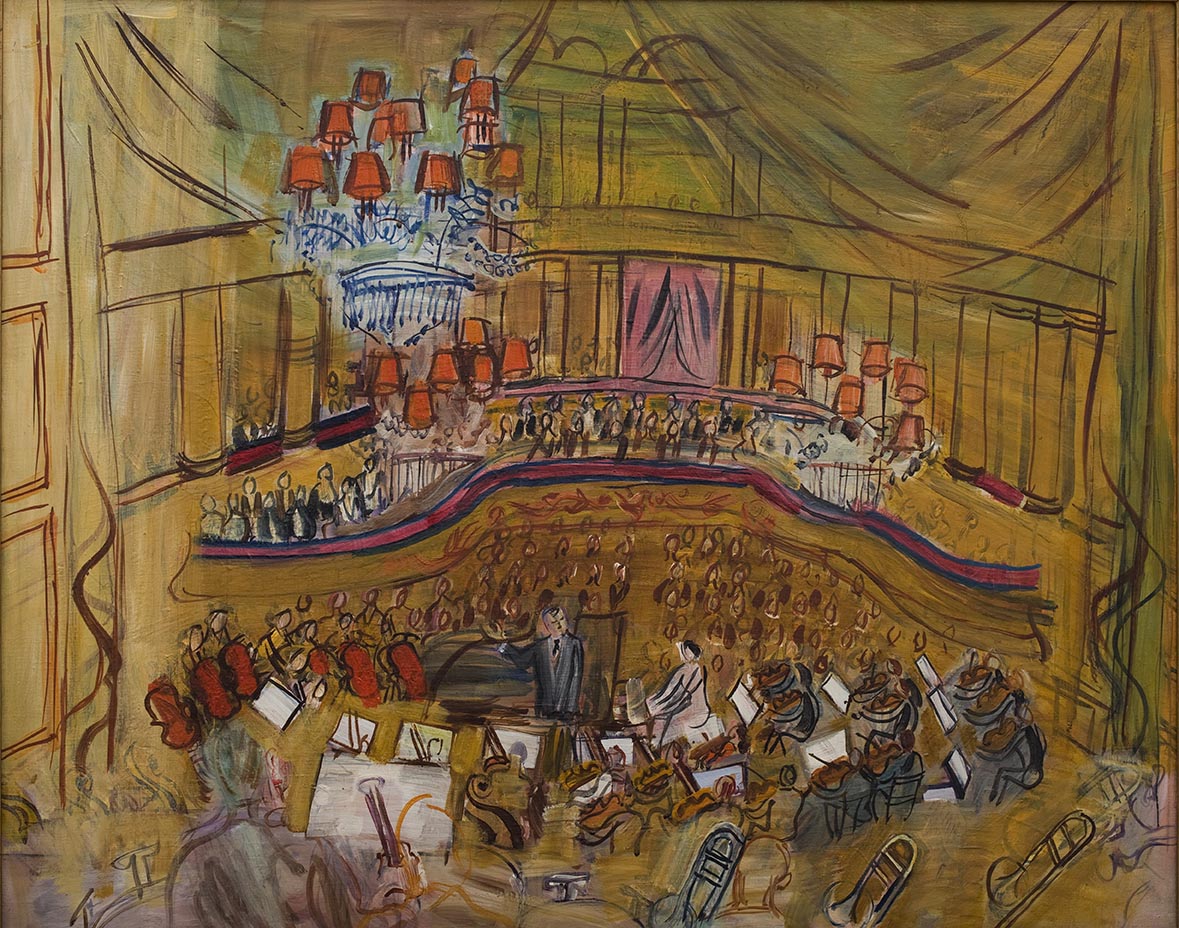
1948
Huile sur toile
Nice, musée des Beaux-Arts Jules Chéret, N.Mba 5618
Legs de Mme Émilienne Dufy en 1962
© Muriel Anssens – Ville de Nice
Dufy was so passionate about music that he sought, through his painting, to find a plastic equivalent to musical sounds. Here, the chamber orchestra invites him to use warm colours gravitating around warm yellow in an attempt to unite sounds and colours.
This painting is part of a series depicting the rehearsals of the orchestra of the Société des Concerts du Conservatoire at the Théâtre des Champs-Elysées.
Fireworks in Nice
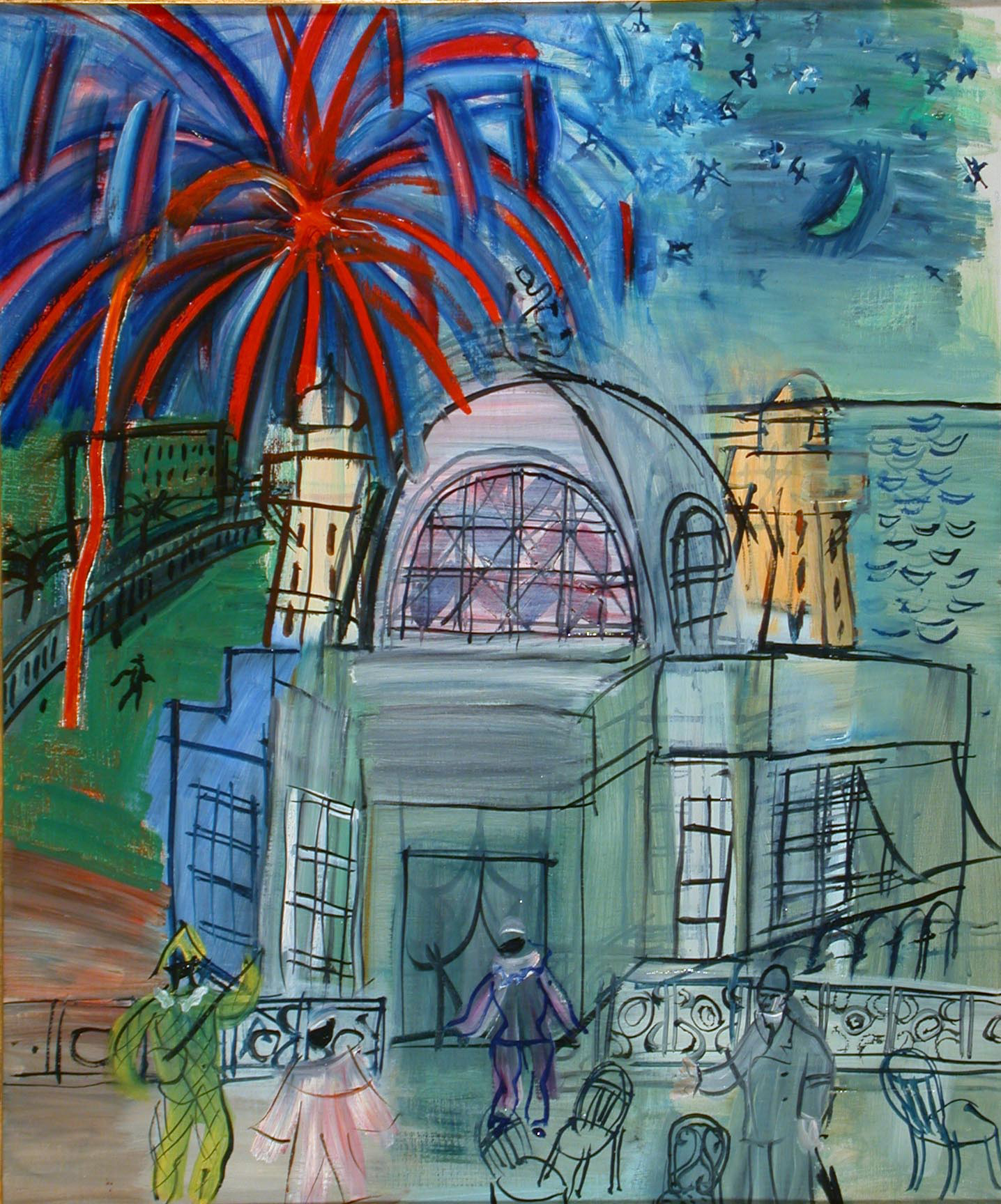
1947
Huile sur toile
Nice, musée des Beaux-Arts Jules Chéret, N.Mba 5616
Legs de Mme Émilienne Dufy en 1962
© Muriel Anssens – Ville de Nice
Dufy amused himself by turning the astonishing building, with its Orientalist-style domes and minarets, into a carnival setting from which a dazzling firework display seemed to emerge. The Jetée-Promenade building was so dear to Dufy that he continued to paint it after it was demolished in 1944.
Émilienne Dufy’s portrait
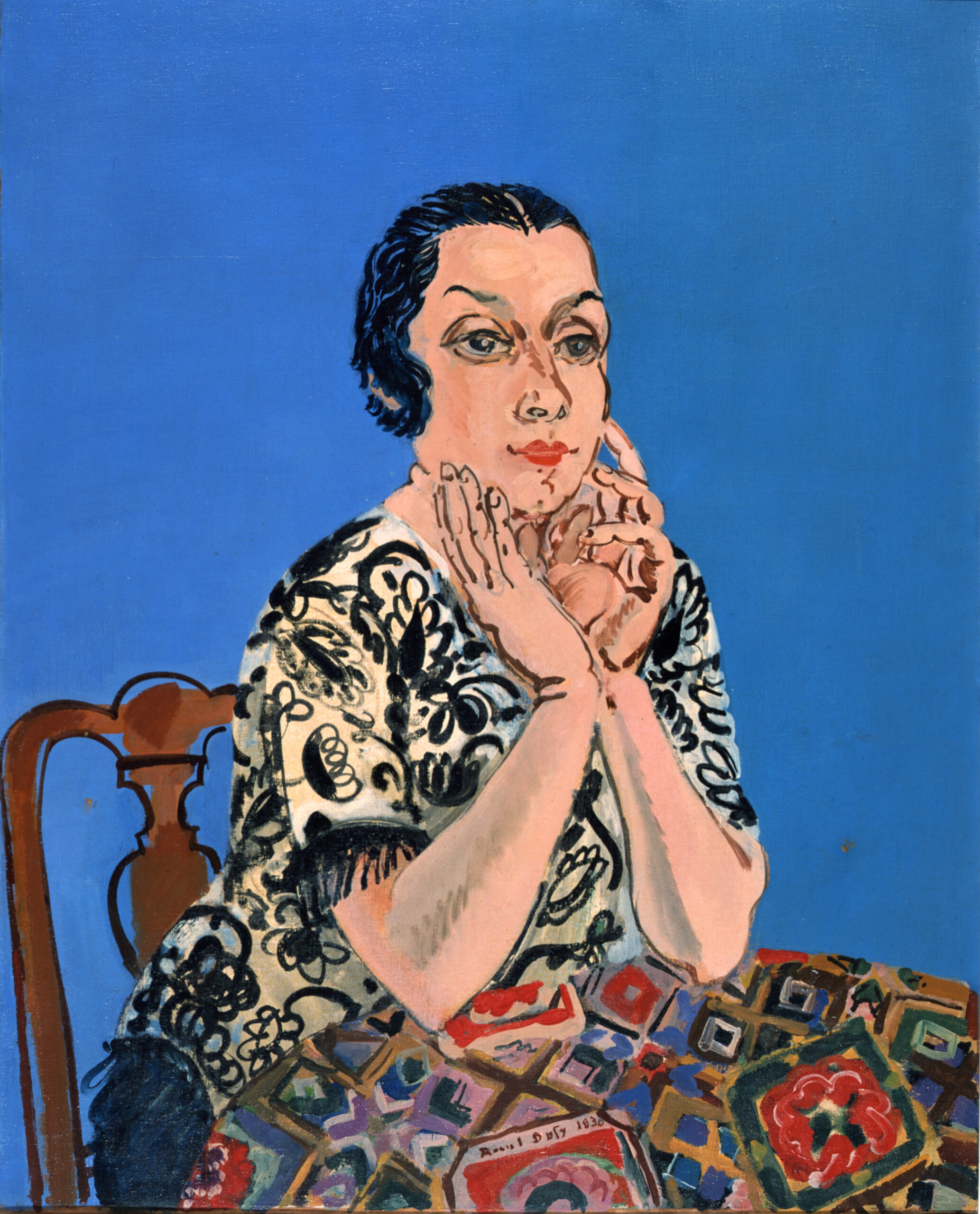
1930
Huile sur toile
Nice, musée des Beaux-Arts Jules Chéret, N.Mba 2851
Don de Mme Émilienne Dufy en 1955
© Muriel Anssens – Ville de Nice
Emilienne Dufy was often portrayed by her husband. In this painting, the combination of the monumentality of the silhouette with the flat colour of the background and the omnipresence of arabesques is a kind of homage to Matisse.