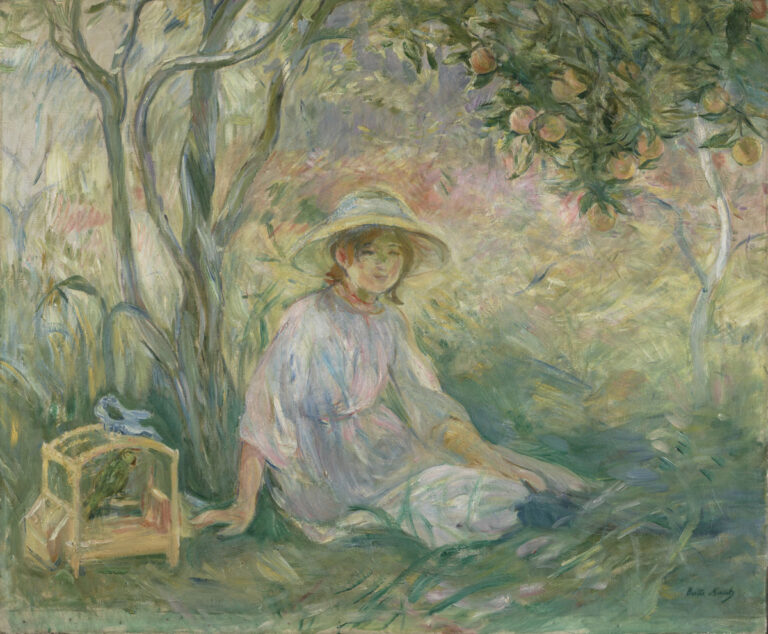
In this year celebrating the 150th anniversary of the birth of the Impressionist movement, the City of Nice and the Jules Chéret Fine Arts Museum are dedicating a major exhibition to Berthe Morisot. Designed as part of the Musée d’Orsay’s territorial operation “150 Years of Impressionism,” in partnership with the Palazzo Ducale in Genoa, and with the decisive support of the artist’s family, “Berthe Morisot in Nice, Impressionist Stages highlights the painter’s two stays on the Riviera during the winters of 1881-1882 and 1888-1889.
This exceptional project, focusing on the first woman to participate in Impressionist exhibitions, explores moments in the life and creation of the painter that have never been the subject of dedicated research. The Jules Chéret Fine Arts Museum brings together for the first time around sixty of her works created on the Riviera, on loan from the Musée d’Orsay, the Musée Marmottan Monet, the Prince’s Palace of Monaco, the Nelson Atkins Museum of Kansas City, the National Museum of Stockholm, the Fine Arts Museum of Lyon, and many other public and private collections.
Among the masterpieces presented are two self-portraits of the artist: Portrait of Berthe Morisot (1885, Musée Marmottan Monet) and Portrait of Berthe Morisot and Her Daughter (1885, private collection) as well as: The Port of Nice (1881, Musée Marmottan Monet), The Beach of Nice (1881-1882, private collection), Niçois Peasant Woman, Célestine (1889, Fine Arts Museum of Lyon), The Mandolin (1889, private collection), Under the Orange Trees (1889, Nelson Atkins Museum, Kansas City) and The Orange Harvest in Cimiez (Grasse, Museum of Art and History of Provence).
The Jules Chéret Fine Arts Museum also unveils paintings by Claude Monet and Auguste Renoir, who were also present on the Mediterranean coast at the same time and captivated by this dazzling environment. The exhibition notably includes The Villas at Bordighera (1884, Musée d’Orsay), a gift from Claude Monet to Berthe Morisot.
The exhibition layout, designed by Architect Anne Gratadour and realized by the workshops of the Nice City Opera, highlights the links that unite Berthe Morisot to the Riviera.
Numerous discoveries resulted from the meticulous investigation conducted during the preparation of the exhibition by cross-referencing sketchbooks and notes, correspondence, and local press. Some works have been located, and others have had their subjects identified. Morisot’s working process and pictorial research are now better understood and more precisely associated with the artistic training of her daughter Julie Manet.
Finally, in resonance with Berthe Morisot’s extraordinary journey as a pioneering artist, a section dedicated to her contemporaries, featuring works by Mary Cassatt, Eva Gonzalès, Marie Bashkirtseff, and Louise Breslau, highlights the remarkable flourishing of female creativity during the Belle Époque on the Riviera.
A reference book is published by Editions Electa. It includes the complete correspondence of Berthe Morisot during her stays on the Riviera, the full publication of a previously unpublished “Niçoise” sketchbook, and an extensive documentary corpus.